|
|
|
|---|
Showing posts with label Concept Cars. Show all posts
Showing posts with label Concept Cars. Show all posts
Thursday, January 6, 2011
New electric concept car, Jaguar C-X75 Specifications and Features
New electric concept car, Jaguar C-X75Tata Motors owned Jaguar has unveiled an electric concept car, named as Jaguar C-X75, and it has been created to celebrate 75 years of the company. This new Jaguar C-X75 concept car had everything a Jaguar should be. More about this new Jaguar C-X75 is that it possesses remarkable poise and grace yet at the same time has the excitement and potency of a true

New electric concept car, Jaguar C-X75 Specifications and Features
New electric concept car, Jaguar C-X75Tata Motors owned Jaguar has unveiled an electric concept car, named as Jaguar C-X75, and it has been created to celebrate 75 years of the company. This new Jaguar C-X75 concept car had everything a Jaguar should be. More about this new Jaguar C-X75 is that it possesses remarkable poise and grace yet at the same time has the excitement and potency of a true
Tuesday, October 26, 2010


Friday, July 16, 2010
2011 Porsche 911 GT2 RS Sports Car

2011 Porsche 911 GT2 RS Sports is one of the greatest sports cars that are going to introduce in August during a famous auto-show at Moscow. As compare to the last model of GT2, this amazing 2011 Porsche 911 GT2 RS have more boost-power. It is much poor faster than the “Dodge Viper ACR”. Unlike the 500-hp Turbo and 530-hp Turbo S, it has six-speed but manual transmission. It is so much fast that it can easily touch the speed of 60 miles per hour within just 3.4 sec. Porsche has ensured that this amazing sports car will reach the speed of 186 miles per hour within just 28.9 sec and its top speed is about 205 miles per hour. It has also mentioned that its weight is much lighter (400 pounds) than the 911 Turbo S which has launched recently. Another important feature that can be seen in this car is its amazing brakes that have made with carbon-ceramics. This new sports car will surely capture the markets of all over the world due to its amazing transmission, efficient engine and many other features. This new 2011 Porsche 911 GT2 RS will be available in October for the dealers. This car will be available in many attractive colors like red, black, and silver and white.
Saturday, June 19, 2010
Toyota FT-HS

By eliminating the "B" pillar and creating a suspended "C" pillar, the minimalist style works in conjunction with subtractive mass.
Volkswagen Concept Car

The most beautifully designed car is a Volkswagen's Futuristic Concept.The Volkswagen cars we will be driving 20 years from now will be sustainable, tailored to fit personal needs and bring a whole new driving experience to the road. The vehicles shown range from the Room, a family vehicle, the Ego, a two seater, and the One, a single rider urban vehicle. All of them are fitted with technologies which are staples of science fiction, but are not quite possible yet at least not in the mass produced scale which is required for them to be economically feasible. Think fully electric vehicles powered by the sun, vehicles that drive themselves, fitted with an all encompassing internet, cars that can tell the mood that you are in, and which are able to speak to other cars in the road.
Monday, June 14, 2010
Latest Fuel Efficient Car

Latest fuel-efficient car versus the latest sports car .Today's oil prices, more efficient ,hybrid and green cars becoming more than just an necessity. Green cars are lucrative and appealing. In a survey made by GM .More than seven in 10 (73 percent) car buyers say if there were a reality TV show like “Project Runway” that was not about fashion design.
Saturday, June 12, 2010
Stone Car

Monday, May 3, 2010
Lamborghini Embolado Concept Car

Lamborghini Embolado Concept
For those who feel Lamborghini’s styling has been severely soften the impact of parent company Audi. The Lamborghini Embolado concept shows a possible design direction that is anything, but soft. The only problem is it is not official.
Created by Italian design student Luca Serafini. The idea of the Embolado came from the Spanish festival Toro Embolado. The bull is the set free in the streets at night.
“The choice of the name was the first step towards the creation of this concept,” says Serafini. He even created a beautiful version of the car with similar styling cues to the recently released Gallardo.
Monday, April 19, 2010
2006 Yes Roadster 3.2 Car
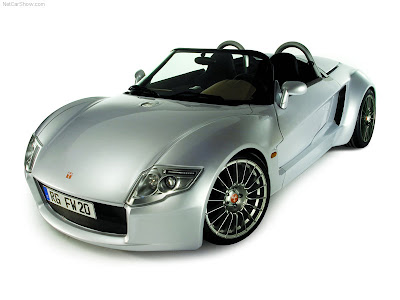
Roadster 3.2 Turbo the concept was taken one-step further: an especially developed rear wing spoiler assures the necessary down force, to bring 355 HP safely onto the street.
The »YES Roadster 3.2 Turbo« is a driving machine that relocates limits. The person driving it has to be capable of accelerating 930 kg in 3.9 seconds to 100 km/h. it is a balancing act between dominating and being dominated. The power is transferred unaltered onto the streets. This is what requires the Turbo driver utter concentration. An experience you will never forget.
The interior is the human-machine interface. This is where the driver takes the command, feels the direct contact to the street, navigates and controls the instruments.
The high-strength aluminum-space-frame takes care of the passive safety. In addition, driver and passenger are protected by optional air bags if necessary.
With variable camshaft settings, the renowned V6 four-valve engine equipped with 3,189 cm3 of engine, displacement in the naturally aspirated as well as in the turbo version combined with a max. Torque already at 2,001 1/min has virtually an easy job with the 890 and 930 kg respectively of the »YES! Roadster 3.2 and 3.2 Turbo In doing so, the fuel consumptive on is only at eight, two and nine, 3 liter respectively on 100 km in the so-called combined fuel consumption.
A 6-speed-manual transmission or alternatively the 5-speed-automatic transmission together with a lengthwise build in power train takes care of the power transmission onto the rear wheels. A rather low shifting effort and precise, short shifting travels allow fast and exact gear changes.
Ventilated brake discs on the front axle as well as on the rear axle provide a maximum deceleration and a well-balanced braking power - also during a continuous run. 4-piston fixed calipers onto the brake discs transfer the braking power.
The pedal force is transferred directly in favor of a superior pedal feel, optionally supported by a Multi-Channel ABS-system which is directly derived from racing.
In addition to the usual high level of passive safety, full-size driver's and passenger's airbags are available for the »YES! Just in case.
We want you to enjoy it as often as possible: open driving. Therefore, we have also found space in the YES. Optional and mostly for the cold season is the new hardtop - easily and quickly assembled the YES! Roadster turns into a coupe!
Saturday, April 17, 2010
IAT-Auto Concept Photos

Wu Feng II Concept Photos

Wu Feng II Concept Pictures

Wu Feng II Concept Images
Unlike Geely and Chery which is relatively known world wide for all the right and wrong reasons, IAT- Auto China is still a relatively unknown newbie and they are going to present 3 decent looking concepts in the upcoming Beijing Motor Show.
First up we have the Wu Feng II which is a follow up to the Wu Feng I. It's a compact coupe with gullwing-style doors that's said to have a top speed of 200km/h or 124mph and can reach 100km/h (62mph) from standstill in 7 seconds.
Next is the the eTAXI, a mid-size sedan powered by an electric motor, and the all-electric Bamboo Wind, a futuristic take on the small MPV segment inspired by nature.


Bamboo Wind Concept

Bamboo Wind concept
Friday, March 5, 2010
Bowler Raptor Concept Car

Bowler Raptor Concept Car
The aggressively styled vehicle features functional body panels, which are held on by easily accessible hex head bolts that can easily be replaced if damaged. The car is designed with an exposed carbon fiber chassis, which is designed to heighten the sense of speed and bring the occupants closer to the action. The alloy wheels of the car are designed to match the aesthetics of the bodywork. The tire and the wheel rim are designed to interlock with each other, giving the much needed strength to the machine. The car is designed to be powered by two lithium-titanate batteries, which fuel a next gen Siemens electric motor coupled to a single speed transaxle.
Safari Eco Concept Car

Eco Safari car is a compact car with large car comforts and stability. The Safari concept is all about giving you all the possible advantages that a heavy vehicle can give you. All the large car dynamics like greater energy absorbing strengthened by independent structural composite fiber panels and sliding door apertures in case of side impacts and rollovers, brings it almost very near to a compact dream car.Head up Display and a center console joystick replaces the conventional interiors. Its structural composite plant fiber body reduces the carbon emissions generated from such industries. The concept sounds great.
Sunday, January 17, 2010
What Bugs Me About Concept Cars
The auto shows are amazing. They show all of these super cool looking cars that are to come and some of the new features on the current model cars. They also show new designs that will be implemented on current cars. As amazing as it is, there is one thing that gets me about these shows. It's the concept cars. Concept cars are cars that are seriously being thought about publicly selling. When
Sunday, September 13, 2009
2009 Aston Martin V8 Vantage Roadster

Aston Martin V8 Vantage - originally launched to widespread critical acclaim at the Geneva Motor Show in 2005 - is to receive significant technical enhancements, reaffirming the car's position as one of the world's most desirable and exhilarating sports cars. While the universally distinctive and award-winning shape of the Aston Martin V8 Vantage is retained, the car benefits from a number of technical changes which include significantly up-rated engine performance from a new 4.7 litre power unit in both Coupe and Roadster variants. Other changes include revised dynamics to take full advantage of increased power and torque availability, improved Sportshift™ transmission software and a new sports suspension option. The 4.7 litre V8 engine has a power output of 420bhp (an 11% increase on the previous 4.3 litre unit) and delivers peak torque of 470Nm (15% increase), providing the Aston Martin V8 Vantage with new reserves of mid-range performance, an improved 0-60mph time of 4.7 seconds and top speed of 180mph (288kph). Combined European fuel economy and CO2 emissions are also improved by 13% (Sportshift™). Inside, the changes include a new centre console and revised switchgear and the introduction of an ECU replacing the previous V8 Vantage key. Externally, the acclaimed Aston Martin V8 Vantage design appearance is enhanced with a range of new standard and optional 19'' alloy wheels. Aston Martin Chief Executive Officer, Dr Ulrich Bez said: "Continued development and evolution of our unique VH (Vertical-Horizontal) architecture has brought even higher levels of refinement and dynamic performance to our whole range. "With the new 4.7 litre engine and associated changes we have taken the Aston Martin V8 Vantage to new levels of performance to produce an even more desirable sports car. "The Aston Martin V8 Vantage is now the most successful Aston Martin in our history and we are confident these changes will continue its appeal and driving enjoyment for both new and existing customers." Engine Improvements in performance have been achieved through a number of carefully developed changes to Aston Martin's acclaimed V8 engine. The cylinder bore and stroke has been increased from 89mm to 91mm and 86mm to 91mm respectively, giving a total displacement of 4735cc. The increase in cylinder bore is facilitated by a move to cylinder liners that are pressed into the pre-machined aluminium alloy block, allowing a thinner liner than was possible with the cast-in design of the 4.3 litre engine. The new forged steel crankshaft provides the 91mm stroke and incorporates new holes in the counter weights for reduced rotating mass and improved inter-bay breathing. New forged steel con-rods and cast aluminium pistons complete the capacity-related changes. Other key changes include efficiency improvements to the dry sump lubrication system, including a new sump casting with oil pick-up points moved from the front and rear to the sides of the sump. The cylinder heads are modified with a new intake port and an inlet valve size increase from 34.9mm to 35.9mm. The intake manifold has been modified to match the new port to optimise air flow. Transmission The Aston Martin V8 Vantage transmissions have also undergone changes to improve performance and to handle the increased levels of power and torque. Both the standard manual stick-shift gearbox and the optional Sportshift™ transmission benefit from a modified clutch and flywheel, reducing clutch pedal efforts and delivering a 0.5kg weight saving, reducing the rotating masses within the powertrain, and hence increasing engine responsiveness. Aston Martin's Sportshift™ transmission has undergone a series of specific changes to broaden the capabilities of the gearbox to offer customers enhanced comfort and convenience with sporting capabilities. Changes include a revised control strategy, allowing the transmission, rather than the engine, to dictate how best the engine torque should be deployed to optimise performance and deliver power smoothly and consistently. 'Dual Throttle Map' software is also featured. When 'Comfort' mode is selected the engine reacts in a smoother more progressive manner to driver throttle inputs and in the default 'Sports' mode the throttle mapping is more aggressive, delivering a more dynamic and sporting feel. Sportshift™ now also has the capability to take inputs from the steering wheel enabling the current gear to be held when the car is negotiating a corner and hill descent detection, allowing a low gear to be held, maximising the effects of engine braking. Suspension A series of improvements are introduced to the Aston Martin V8 Vantage chassis and suspension setup to deliver improved body control and low speed ride quality; enabling the driver to take full advantage of the increased performance potential. A number of the improved components originally introduced on the Aston Martin V8 Vantage Roadster are now carried over to the Coupe, including revised upper damper mountings and bump stops. Additionally, the front spring rates are stiffened by 11% at the front and 5% at the rear. Steering geometry is also modified to improve steering feel, while the front lower suspension arm compliance bushes are stiffened by 22% to provide enhanced steering response and handling. The Aston Martin V8 Vantage also now benefits from Bilstein dampers as standard; these low-friction dampers provide improved levels of dynamic capabilities and further improve ride quality. Design & Optional Equipment Also introduced as an option for both Coupe and Roadster variants is a new Sports Pack which comprises forged lightweight alloy wheels aiding a lower unsprung mass, re-tuned Bilstein dampers with improved dynamic response, up-rated springs and a revised rear anti-roll bar (Coupe only). The Sports Pack is intended to offer greater agility, high speed body control and precision feel for the most enthusiastic of drivers. Although the award-winning exterior design of the Aston Martin V8 Vantage remains largely unchanged, a new 20-spoke 19'' alloy wheel is introduced as standard, with either diamond turned silver or graphite finishes available as options, affording customers maximum choice. Alternatively, as part of the Sports Pack option, a 5-spoke lightweight aluminium wheel will be provided. In the cabin, a new centre console constructed from die cast zinc alloy with a graphite silver finish is introduced along with a new ECU - first seen on the Aston Martin DBS in 2007. The ECU - constructed from glass, polished stainless steel and polycarbonate - replaces the key used previously for the Aston Martin V8 Vantage. The revised car also includes a new Hard Disk Drive (HDD) Navigation System offering faster route processing, additional features and improved graphics. Full ipod/MP3 integration is retained as standard equipment. First shown as a concept car at the 2003 North American International Auto Show in Detroit, the Aston Martin AMV8 Concept caused a worldwide sensation as it allowed Aston Martin to enter a new sector of the premium sports car market with a genuine alternative to other cars on offer. Deliveries of the Aston Martin V8 Vantage Coupe to customers began in late 2005, joined by a convertible sibling in 2007 when the Aston Martin V8 Vantage Roadster was launched. The car is hand built at Aston Martin's Headquarters at Gaydon, Warwickshire, UK and to date more than 10,000 have been delivered to customers around the world.
2009 Aston Martin Lagonda Concept
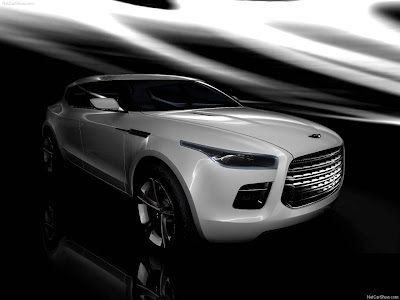
Aston Martin Lagonda concept is celebrating 100 years of manufacturing cars under the brand name Lagonda, stunning modern evolution of this flag name. Lagonda marries modern functionalism with luxury, based on organic forms, rich materials and complex surfaces. The car is based on the best platform, which, taking into account a wide range of future powertrains, including flexfuel, low-emission diesel and hybrid systems. Aston Martin Lagonda concept is composed of four seats in the International Tourer, avant-garde luxury car, which draws inspiration from the outstanding brands the past, as well as the visual language of high-speed design, spacious individualistic environment of higher class cabins and custom feel of contemporary modern furniture. Within four generous seats are divided into two zones, front and rear. As a result, relaxed, rich environment that envelops you in a warm, tactile materials. Marek Reichman, Aston Martin design director, a description of Aston Martin Lagonda concept design language as a synthesis of liquid form mixed with hard, constructed lines. This organic, emotional approach eschews a vertical surface in a broad, flowing around the body and spacious passenger cabin. A clear distinction between cabin, shoulder and flank strongly resembles a powerful and flags lines Lagondas era of 1930's and, in particular the V12 engine option LG6. Viewed from the front of the concept, the deep, strong grating is also the presence and elevation of the cars from the interwar period. Brave character lines that run along the sculpted flanks to the rear to ensure the concept is firmly planted on the road. Large 22 "wheels and cut-out of the body offer exceptional ground clearance, but the concept V12 engine provides power through all four wheels. Modern automotive brand must have strong core values and a wide range of possibilities. Modern Lagonda will lead to long-distance car, a vehicle that combines luxury cosseting extreme functionality and technical innovation. Lagonda name is an integral part of the history of Aston Martin since 1947. Aston Martin Lagonda concept shows how the brand will once again stand together with Aston Martin, as the perfect complement to today's performance. Lagonda stands for functional elegance, performance, simplicity and convenience. "Lagonda will create a new type of relationship with clients, foster the spirit of travel, adventure and style in a single package with a huge," said Dr. Ulrich No. "The agenda for the Aston Martin requirements management. Lagonda required destination. Lagonda: the revival of brand luxury Aston Martin is proud to announce the return of Lagonda, one of the landmark names in the luxury car production. The aim is to Lagonda market with a unique product of luxury performance car that combines exceptional ability with unsurpassed elegance, inside and out. Lagonda return signal a significant expansion of Aston Martin production, taking the company into new and emerging markets worldwide. To demonstrate the vision Lagonda, Aston Martin Lagonda concept car was created, which epitomises the crossing vessels, design and technology with a high-performance Aston Martin examination. Aston Martin Lagonda concept of avant-garde luxury car with a powerful four-wheel drive, four-seat car that will satisfy the most demanding owner. The concept demonstrates the commitment to innovative technologies, new materials and elegant forms. "The Lagonda luxury car is the future," said Aston Martin chief executive, Dr Ulrich Without, "a combination of general convenience, new forms and new technologies and materials." Back Lagonda meets the long term. Aston Martin modern era began in 2001 with the launch V12 win awards and build its headquarters in Gaydon, Warwickshire in 2003. In subsequent years, Aston Martin has started four classes of leading new products, revitalize the GT category and the revision of automotive beauty. Aston Martin range of award-winning DBS, DB9, Vantage and forthcoming quickly, and one-77, represent some of the most beautiful high performance cars are built elegant, highly developed and very well engineered. Aston Martin will always be sports cars, as well as a modern, exclusive and beautiful, it calls for the government, the unique nature of that reward for enthusiasts, both on road and track. First of all, Aston Martin creates an emotional reaction. This machine with a soul. Under the leadership of Dr Ulrich No, Lagonda luxury performance will bring in new markets and territories worldwide. Reflecting its remarkable history, Lagonda will return to Russia, to enter new markets in the Middle East, South America, India and China, as well as in response to demand from a dynamic, innovation-oriented consumers in Europe, North America and the Far East. Not only Lagonda Aston Martin to join the existing core markets, and the unique nature of the new brand will help take the company more than 100 territories worldwide and the expansion of the brand to new customers. "The agenda of Aston Martin is a true, pure sports car," said Dr. Ulrich No, but the Lagonda is something else that the new brand will have access to new markets and have different values for the Aston Martin. " Heritage Lagonda is one of the greatest names in automotive history, brands associated with luxury, performance, grace and exclusivity. Since the first Lagonda production cars was built 100 years ago, born in the United States, Wilbur Gunn, name Lagonda has undergone several incarnations before he soon began to Excel in the creation of racing cars and sports sedans.
Gunn first car was built in his home workshop in Middlesex, England in 1909. In 1910, forced him to Gunn 16/18hp Lagonda Tourer to victory in the Russian judicial Reliability, spectacular developments in the conduct of the Imperial Automobile Club of Russia's public relations exercise in the country's emerging road system. Win brought a lot of orders, and Gunn has focused on the Russian market, the creation of the dealers in St. Petersburg and Moscow in 1910. In truth, Russia's roads, introduced students to the enormous traffic and route, which includes St. Petersburg, Riga, Kiev and Moscow, was a strict test for any car. Gunn is a testament to the success of Lagonda in and build a solid operational performance. It was not until the next year, which began marketing Lagonda cars in the country, starting a limited production of light vehicles, which was eventually stopped by the First World War. Throughout the 20's and 30's the company expanded its premises in Staines, England, taking into account the vehicles yield more substantial touring models. Lagonda came to epitomise Edwardian passion to create new records and exploring new territory, with robust and reliable vehicles that can be easily determined trans-continental links. In 1933, the manufacturer began M45 at Olympia Motor Show in London, sports nutrition from the Tourer Henry Meadows developed six-cylinder 4.5-liter engine. The prototype was driven aristocrat and enthusiast, Edward Russell, Lord de Clifford, from Dieppe in Brindisi to Greece, beating Express on the same route about 14 hours. As a result, it was the media sensation. M45 quickly became known as a vehicle for the discerning sportsman, fast and capable but also quite useful for long journeys. At one time it was the largest engine in its class, the distinction that attracted the owners of the land, as the speed record holder Sir Malcolm Campbell, who was his M45 painted in his signature blue.
The emerging sport of long-distance, endurance racing is also an integral part of Lagonda development. In June 1935, lightweight version of M45 won the Le Mans 24 hours a day, with John Hindmarsh and Luis Fontes at the wheel. This was a landmark achievement for the brand, as well as HighPoint British sports car racing in the interwar period after the heyday of Bentley in 1920-ies. In the same month, was acquired Lagonda Alan Fine, a charismatic British lawyer whose first task was to seek qualified engineer WO Bentley. The results were LG45 Frank Feeley style that represented the pinnacle of engineering skills of time. In 1936, W.O. Bentley developed the first Lagonda V12, the engine, which was perfectly at home in the majestic long-wheeled version of the new chassis. Lagondas in the 1930's demonstrated a general harmony between the engineering and appearance, including the stately LG6 model introduced in 1937. W.O. Bentley good innovation and refinement throughout the war, and the company has developed LG6 model V12, even more imposing and dignified 'cabin, which, unfortunately, ceased production before the war. At the same time, engineers have developed a new six-cylinder engine, the War, the advantages of which were soon on the Aston Martin. Aston Martin Lagonda in collaboration with started in 1947 when David Brown, marque a new owner bought the company for £ 52500. Cooperation has access to the Aston Martin WOBentley new 2.6L DOHC six cylinder engine, as well as the talents of long body stylist Frank Feeley. Feeley is responsible for the elegant drophead version of the new 2.6 liter, the first of the David Brown era Lagonda production from 1948 to 1953. At the end of 1952, the 2.6 liter was developed in 3.0 liters, which is used a revised version of WO Bentley engine. The two-door sedan was soon joined by the four-door coupe and the drophead. Next Lagonda was developed tourist rapid response in 1963, the sleek four-door sedan, which shares many components with the Aston Martin DB4. Fifty-five were built, of which 48 survived. In the late 1960's, Aston Martin head designer William cities, a new four-door sedan from the Aston Martin DBS. Only seven cases have been built in the mid 1970's. In 1976, Aston Martin Lagonda has announced a new era, a unique, innovative car developed by William Cities in the contemporary 'wedge' of fashion, he made his own. Permalink aesthetically and technologically different from the range of Aston Martin, Lagonda was a bold and experimental, high performance luxury saloon a truly discerning. Lagonda name was briefly revived for the Vignale concept, the introduction of a luxury sedan, which was established to develop Ghia in 1993. One example survives. The name is also used for a strictly limited production Virage Lagonda saloon and shooting brakes in 1994. Lagonda stories is a long and eventful, including the two most important figures in twentieth-century British engineers, WOBentley David and Brown, racing fame, and some of the most dramatic designs in automotive history. In the 21 th century, Lagonda will return, bringing a sense of adventure and the avant-garde in the market of luxury cars, in honor of the remarkable history, as well as make a bold statement for the future.
2009 Aston Martin Cygnet Concept

Aston Martin has developed a new luxury commuter concept; the 'Cygnet' which will offer customers a distinctive, intelligent and exclusive solution for urban travel in style and luxury. The concept will offer Aston Martin trademark design in a commuter car package based on the critically acclaimed Toyota iQ with a Euro NCAP 5-star safety package. The 'Cygnet' concept represents a creative, environmentally conscious solution, being small, yet with presence - and highly fuel efficient, now combined with the prestige of Aston Martin's luxury brand ownership. Aston Martin, the world leader in exclusive niche engineering is collaborating on this concept with Toyota the world leader in volume, quality and reliability. Although vastly different in size, Toyota and Aston Martin share the philosophy of engineering excellence and innovation underlined by a strong passion for cars. Aston Martin Chief Executive, Dr Ulrich Bez said: "Now is the right time for Aston Martin to take this first bold step to embark on this special project - made possible with the support of an organisation of Toyota's stature and capability and the intelligent design and perfect city car package of the iQ." "Much work is still required, but I am confident that this project could become reality in the not too distant future. This concept - akin to an exclusive tender to a luxury yacht - will allow us to apply Aston Martin design language, craftsmanship and brand values to a completely new segment of the market." "The offering of a 'Cygnet' with a DBS, DB9 or Vantage is a unique combination of opposites and a novel transport solution allowing intelligent and sensitive mobility on an exclusive and innovative level.
Tuesday, September 8, 2009
2007 Aston Martin V12 Vantage RS

At the official opening of Aston Martin's first ever dedicated design center in Gaydon, Warwickshire, on Tuesday 11 December, Dr Ulrich Bez, Chief Executive Officer, thrilled an audience of more than seven hundred VIP guests with a surprise unveiling of a stunning new 600bhp performance concept car; the V12 Vantage RS. The V12 Vantage RS concept is based on Aston Martin?s critically acclaimed V8 Vantage coupe, but the company?s design and engineering team have fully exploited the design flexibility of their unique VH architecture and the motor sport development of their 6.0 litre V12 engine to create a dramatic and production feasible concept car focussed on extreme performance and dynamics. In a speech to the assembled guests, Ulrich Bez said: ?Over the last five years, we have established a reputation for presenting fully functional, feasible concept cars, and the V12 Vantage RS is no exception. We will listen with interest to feedback on this concept and, as ever, if there is sufficient demand then we will seriously consider a low volume production run in the near future with a price that will reflect the exclusivity of the car. ?With our dedicated production facilities, our own engine plant, our own unique vehicle architecture and now a dedicated design studio, we have the ideal framework to bring new models such as this to market and to further establish Aston Martin as the ultimate independent luxury sports car company.? Although the 600bhp power output of the V12 Vantage RS concept will be the focus of attention, just as significant is the level of weight reduction achieved by Aston Martin?s engineering team. With a kerb weight of less than 1600kg, the RS concept underlines Aston Martin?s continued commitment to intelligent use of materials and weight reduction as a means of achieving improved efficiency and performance. In common with the recently launched DBS, the bonnet and trunk lid are moulded in carbon fibre and the concept also adopts motor sport-inspired carbon ceramic brake discs. The subtly aggressive exterior appearance is driven by function. The dramatic bonnet louvres extract air from the fully ducted cooling pack and the trunk lid features a deployable spoiler that rises automatically at high speeds to increase rear down force. The front bumper features cooling ducts for the carbon ceramic brakes and a carbon fibre splitter to balance down force. Director of Design, Marek Reichman, commented: ?Much of Aston Martin?s recent success has come from the ability of our designers and engineers to work hand-in-hand to optimise form and function. Our new dedicated design centre will take this process to a new level and I am delighted that the V12 Vantage RS is the first car to stand on the turntable in the studio.? The 600bhp 6.0 litre engine featured in the V12 Vantage RS concept has benefited directly from the race development of this acclaimed power unit. It features a dry sump lubrication system, tuned length exhaust manifolds, forged pistons and steel con-rods, revised lift and duration camshafts and modified cylinder heads. Peak power is achieved at 6250rpm and peak torque of 690Nm is at 5000rpm. With a power-to-weight ratio of over 375bhp per ton, the V12 Vantage RS concept is the fastest accelerating road car ever built by the company, capable of reaching 62mph (100km/h) from rest in 4.0 seconds and 100mph (160km/h) in just 8.5 seconds. The unveiling of the Aston Martin V12 Vantage RS concept concludes a remarkable year of new product announcements for the British manufacturer. In the last twelve months the company has launched two of the most eagerly anticipated sports cars of the year ? the DBS and Vantage Roadster ? and announced details of the DB9 LM and V8 Vantage N400 special editions which celebrate the company?s racing successes at Le Mans and the N?rburgring. All of these models now join the award-winning V8 Vantage, DB9 and DB9 Volante models in production at the company?s Gaydon headquarters.
2007 Aston Martin V8 Vantage

Aston Martin has again reinforced the new direction the company is taking by unveiling a spectacular concept car that is destined to become the most significant model in the company's 89-year history. Previously codenamed AM305, the Aston Martin AMV8 Vantage is the basis for a smaller third Aston Martin model, due to be launched in 2005, and will sit alongside the DB7 and the flagship Vanquish. The AMV8 Vantage will be hand-assembled at Aston Martin's state-of-the-art production facility at Gaydon, in the United Kingdom, which is currently under construction. The name Vantage – which will also be adopted for the production version - was chosen due its long historic links with Aston Martin. This time it's a specific model name rather than denoting a high performance version. The AMV8 Vantage is a tailored two-seater sports car that retains a front mid-engine/rear-wheel drive layout. Its design work was undertaken by Henrik Fisker, Aston Martin's Design Director, and his key objective was to produce a thoroughly modern Aston Martin. Another aim was to ensure that the interior layout and equipment were unique to Aston Martin and could be easily carried over into the production car. There are also a number of traditional Aston Martin design cues which have been incorporated into the AMV8 Vantage's styling such as the front grille shape and the typical side strakes found on all Aston Martin models.
Saturday, August 2, 2008




Subscribe to:
Posts (Atom)


