Showing posts with label cars battery. Show all posts

Saturday, August 14, 2010

Jeep Renegade Concept (2008)

Jeep Renegade Concept (2008)
The advanced propulsion system in the Jeep Renegade concept starts with a 40-mile lithium-ion battery pack. A range extender - in Renegade's case, a small-displacement (1.5-liter, 3-cylinder) BLUETEC diesel engine - allows for journeys beyond 40 miles. In fact, the Jeep Renegade concept boasts a 400-mile range.

Renegade's BLUETEC diesel engine generates an additional 115 horsepower when needed, while greatly reducing exhaust emissions when compared to standard gasoline engines. Renegade is capable of achieving an equivalent petroleum fuel economy of 110 miles per gallon, which is four-to-five times greater than an equivalent gasoline-only vehicle.

The all-new Jeep Renegade concept's lightweight aluminium architecture and regen-braking system help to improve overall efficiency, while dual electric 200 kilowatt (268 horsepower) motors propel a very capable 4x4 system - complete with low range and locking differentials -- worthy of carrying the Jeep name.

 Layout: Four wheel drive with low range and locking differentials,Motor: Dual electric,Power: 200 kW (268 hp) x 2,Regenerative braking,Battery: 16 kWh Li-ion battery pack,Range extender: 1.5-liter, 3-cylinder diesel,Fuel volume: 10 gallons.

Saturday, July 31, 2010

2010 Aston Martin DBS Volante

2010 Aston Martin DBS Volante


2010 Aston Martin DBS Volante , works on a petrol engine that runs with a speed of 6500 rpm and that has a 6L and 48v petrol capacity.

Fuel consumption of 7.225 kmpl on highways and 4.675 kmpl in city can be achieved with 2010 DBS Volante car that has 6 manual gears.


Following are the parts present in 2010 DBS Volante, Battery Saver, Front Power Outlet, Battery, Traction Control, Rear Limited Slip Differential, Dynamic Stability Control (DSC) Vehicle Stability Control System, Brake Assistance, Electronic Brake Force Distribution, Hard Drive, In-Glass Radio Antenna, Automatic Climate Control and Analog Clock.


Tachometer, Cruise Control, Tire Pressure Monitor, Engine Start and Stop Button, Electroluminescent Instrumentation, Engine Start and Stop Button, Electroluminescent Instrumentation, Trip Computer, Front Map Lights, Carpet Located In Passenger Cabin and Trunk, Carbon Fiber Trim Located On Doors and Door Handles, Leather Steering Wheel, Front Floor Mats and Power Windows are present.


2010 DBS Volante is made available in the 10 colors of Almond Green, Amethyst Red, Custom Exterior Color, Emerald Green, Fire Red, Glacial Blue, Hammerhead Silver, Hardly Green, Jet Black, Lightning Silver .

Dimensions of 2010 DBS Volante are 1280 mm of height, 4722 mm of length, 1905 mm of width and weight is 1810 kgs with 5 seating capacity and 4 doors.


Technical Specification


* Body

o Two-door convertible body style with 2+2 seating

o Bonded aluminium VH structure

o Aluminium, magnesium alloy and carbon-fibre composite body

o Extruded aluminium door side-impact beams

o High Intensity Discharge (HID) headlamps (main beam)

o LED rear lamps and side repeaters

* Engine

o All-alloy, quad overhead camshaft, 48-valve, 5935 cc V12

o Compression ratio 10.9:1

o Front-mid mounted engine, rear-wheel drive

o Fully catalysed stainless steel exhaust system with active bypass valves

o Max power: 380 kW (510 bhp / 517 PS) @ 6500 rpm

o Max torque: 570 Nm (420 lb.ft) @ 5750 rpm

* Performance

o Acceleration: 0-100 km/h (0-62 mph) in 4.3 seconds

o Max speed: 307 km/h (191 mph)

* Transmission

o Rear-mid mounted, six-speed manual gearbox. Rear-mid mounted 'Touchtronic 2' six-speed gearbox with electronic shift-by-wire control system

o Alloy torque tube with carbon fibre propeller shaft

o Limited-slip differential

o Final-drive ratio 3.71:1 (manual) 3.46:1 (Touchtronic)

o Wheels and Tyres

o Front: 8.5" x 20" Pirelli P Zero 245/35

o Rear: 11" x 20" Pirelli P Zero 295/30

* Steering

o Rack and pinion, Servotronic speed-sensitive power-assisted steering, 3.0 turns lock-to-lock

o Column tilt and reach adjustment

* Suspension

o Front: Independent double wishbone incorporating anti-dive geometry, coil springs, anti-roll bar and monotube adaptive dampers

o Rear: Independent double wishbones with anti-squat and anti-lift geometry, coil springs, anti-roll bar and monotube adaptive dampers

o Adaptive Damping System (ADS) with Track mode

* Brakes

o Front: Ventilated carbon ceramic discs, 398 mm diameter with six-piston callipers

o Rear: Ventilated carbon ceramic discs, 360 mm diameter with four-piston callipers

o Dynamic Stability Control (DSC) with Track mode

o Anti-lock Braking System (ABS)

o Electronic Brakeforce Distribution (EBD)

o Emergency Brake Assist (EBA)

o Traction control

* Dimensions

o Length: 4721 mm (185.9")

o Wheelbase: 2740 mm (107.9")

o Width:

+ 1905 mm (75") (exc. Mirrors)

+ 2060 mm (81.1") (inc. Mirrors)

o Fuel tank capacity: 78 litres (17.2 Imp.galls, 20.5 US galls)

o Height: 1280 mm (50.4")

o Weight: 1810 kg

Wednesday, July 21, 2010

Mercedes-Benz F800 Style Concept (2010)

Mercedes-Benz F800 Style Concept (2010)
The Mercedes-Benz F800 Style Concept is showing the future of premium automobiles from a new perspective, as the five-seat premium sedan combines highly efficient drive technologies with unparalleled safety and convenience features and an emotive design idiom, which interprets current Mercedes-Benz styling in line with the brand's hallmark attribute of refined performance. The F800 Style has a spacious interior full of intelligent seating, operating, and display concepts."The new Mercedes-Benz F800 Style Concept research vehicle combines this commitment to providing the leading innovative drive concepts with our traditional Mercedes strengths in the areas of design, safety, comfort, and outstanding performance.The Mercedes F800 Style Concept is a very dynamic expression of the concept of "fascination and responsibility." Its drive unit consists of a V6 gasoline engine with an output of 300 hp with next-generation direct injection and a hybrid module with an output 109 hp so that it delivers a total power of around 409 hp.The lithium-ion battery with a storage capacity of >10 kWh can be recharged either at a charging station or a household power socket. Due to its efficient drive system and a CO2 bonus for the battery-electric driving mode, the vehicle has a certified fuel consumption of only 2.9 liters of gasoline per 100 kilometers. This corresponds to extremely low CO2 emissions of only 68 grams per kilometer.The Mercedes-Benz F800 Style Concept equipped with a Plug-in Hybrid nevertheless has a driving performance comparable to a sports car (0-60 mph 4.7 s, top speed of 155 mph).The Mercedes-Benz F800 Style Concept has a top speed of 75 mph.With the new hybrid module, the top speed of the Mercedes F800 Style Concept with Plug-in Hybrid has been increased to 75 mph in electric mode compared to the Vision S500 Plug-in Hybrid. At the same time, it emits only 68 grams of CO2 per kilometer, compared to the latter vehicle's 74 grams per kilometer.

Monday, July 5, 2010

Mercedes SLS AMG E-Cell Concept

Mercedes SLS AMG E-Cell ConceptMercedes SLS AMG E-Cell ConceptMercedes SLS AMG E-Cell Concept
The Mercedes-Benz SLS AMG E-Cell, the performance brand of Mercedes-Benz is launching a totally innovative drive solution for super sports cars and as such is among the pioneers in this market segment.The ground-breaking drive system of the technology vehicle boasts some outstanding features: powerful traction is provided by four synchronous electric motors with a combined peak output of 392 kW and a maximum torque of 880 Nm. The four compact electric motors each achieve a maximum rpm of 12,000/rpm and are positioned near to the wheels. As a result, compared with wheel-hub motors the unsprung masses are substantially reduced. One transmission per axle transmits the power.

Acceleration from zero to 100 km/h in 4 seconds. When it comes to dynamics, the electrically-powered SLS AMG makes a statement: the gullwing model accelerates from zero to 100 km/h in 4 seconds - which almost puts it on the same high level as the Mercedes SLS AMG with 6.3-litre V8 engine developing 420 kW (571 hp), which can accelerate to 100 km/h in 3.8 seconds. Further exciting touches are provided courtesy of the agile accelerator response and the straight-line performance: unlike the combustion engine, torque build-up with an electric motor is instantaneous - maximum torque is available virtually from a standstill. The spontaneous torque build-up and confident power delivery - which does not suffer from any interruption of tractive power - are combined with engine running characteristics which are totally free of vibration.

The Mercedes-Benz SLS AMG E-Cell drive incorporates a liquid-cooled high-voltage lithium-ion battery featuring a modular design with an energy content of 48 kWh and a capacity of 40 Ah. The maximum electric load potential of the battery, which consists of 324 lithium-ion polymer cells, is 480 kW, which is an absolute best value in the automotive sector. Another technical feature of this considerable performance is the intelligent parallel circuit of the individual battery modules - this also helps to maximise the safety, reliability and service life of the battery. The 400-volt battery is charged by means of targeted recuperation during braking whilst the car is being driven.

Renault DeZir Concept

Renault DeZir ConceptRenault DeZir ConceptRenault DeZir ConceptRenault DeZir Concept
The Renault DeZir project is the first to have been led by Laurens van den Acker and marks the start of a sequence of concept cars that will provide an insight into Renault Design's new vision for the future. It also lays the foundations for the styling cues of Renault's forthcoming vehicles.


AN ELECTRIC BEAUTY

Renault DeZir is powered by an electric motor mounted in a mid-rear position to optimize weight distribution over the front and rear wheels. The vertically-mounted 24kW/h lithium-ion battery is located behind the benchseat and provides the car with a range of 160km. Battery cooling is ensured not only by the air channelled from the front to the back of the car, but also - and above all - by the flow of air that enters through the lateral scoops concealed behind the aluminium panels on either side of the body. The basic motor is the same as the unit used for Renault's production electric cars, although an evolution has enabled its power and torque to be uprated to 110kW (150ch) and 226Nm respectively.

Three battery-charging methods can be employed:

    * a standard charge using a conventional household plug (fully charges the battery in eight hours).

    * a fast charge using a 400V three-phase current (charges the battery to 80 per cent of its capacity in 20 minutes).

    * a fast battery exchange thanks to Renault's Quick Drop technology.


Dimensions

    * Length: 4,225 mm

    * Width: 1,968 mm

    * Height: 1,163 mm

    * Height, with doors open: 2,256 mm

    * Width, with doors open: 2,682 mm

    * Ground clearance: 110 mm

    * Wheelbase: 2,582 mm

    * Front track: 1,600 mm

    * Rear track: 1,705 mm


Technical data

    * Motor: Electric synchronous motor with rotor coil

    * Power: 110 kW / 150 hp

    * Maximum torque: 226 Nm

    * Top speed: 180 km/h

    * Acceleration 0-100 km/h: 5 seconds

    * Acceleration 0-50 km/h: 2 seconds

    * Battery: Lithium-ion (24 kW/h)

    * Range: 160 km

    * Transmission: Rear-wheel drive; Direct, drive, with reducer and forward/reverse inverter

    * Drive: Electric with active differential

    * Chassis: Tubular steel frame

    * Wheels and tyres: 245/35 R 21

    * Diameter of ventilated brake discs: 356 mm (front and rear)

    * Callipers: 6 pistons (front and rear)

    * Cd (drag coefficient): 0.25

    * Kerb weight: 830 kg

Monday, June 28, 2010

Gordon Murray T.25

Gordon Murray T.25 Gordon Murray T.25 Gordon Murray T.25


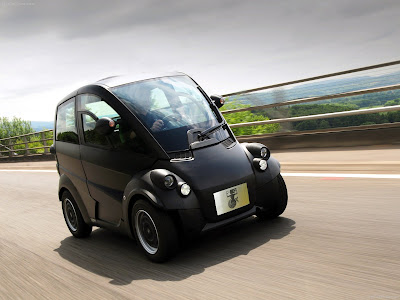
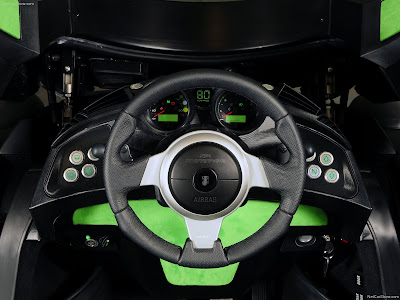
Gordon Murray Design's T.25 City Car will make its first public appearance at the Smith School's World Forum on Enterprise and the Environment in Oxford.A world leading 6 metre turning circle will help with urban manoeuvring and parking whilst its 1.3 metre width opens any opportunity for timed lane zones with 2 vehicles travelling and over taking in one lane.This reduces capital investment in the assembly plant by at least 80%.The ultra lightweight by design (approximately 550kg) means that:component life is increased. Reduced energy is required to power vehicle, giving rise to higher fuel efficiency (mpg/electric battery range).A competitive power to weight ratio is achieved.Six internal layout options with rear seat adjustment (adjustable within 20 seconds) sets new standards in small vehicle packaging - a long way in front of the Smart For 2 and the Toyota iQ.Occupant capacity of between 1 and 3 persons. Luggage capacity of between 160 litres and 720 litres.

Sunday, June 20, 2010

Mercedes SLS AMG

Mercedes SLS AMG


The styling of the new Mercedes-Benz SLS AMG is not only very special because of the exclusive gullwing doors.The E-SELECT shift lever, whose styling recalls the thrust control of a jet, controls the AMG SPEEDSHIFT DCT 7-speed sports transmission. All the controls are made out of solid metal, with a high-sheen Silver Shadow surface.At the design stage great attention was paid to the widest possible opening angle - it is a full 70 degrees. Equally importantly, the distance between the open doors and the road surface is a generous 1.50 metres, while the entry aperture between the open doors and the upper edge of the door sills measures no less than 1.08 metres. The entrance height, i.e. the distance between the road surface and the upper edge of the door sills is a very low 45 centimetres.The feeling of comfortable spaciousness is in large measure due to the generous shoulder-room of 1483 millimetres and elbow room of no less than 1606 millimetres. The luggage compartment can hold up to 176 litres. The Mercedes-Benz SLS AMG is also breaking the mould when it comes to the body concept: for the first time, Mercedes-Benz and AMG are presenting a car with an aluminium chassis and body. Compared with the traditional steel design, this results in a significant weight saving, clearly illustrated in the DIN kerb weight of 1620 kilograms.45 percent of the intelligent, weight-optimised aluminium spaceframe is made out of aluminium sections, 31 percent out of aluminium sheet, 20 percent out of aluminium cast and 4 percent out of steel. Maximum occupant safety requires the use of ultra-high-strength, heat-formed steel in the A-pillars. The bodyshell weighs 241 kilograms - an absolute benchmark in the super sports car segment when compared with the peak output of 420 kW/571 hp.

The Mercedes-Benz SLS AMG consumes 13.2 litres per 100 kilometres (combined, provisional figure), earning it a place at the top of the competitor rankings. Efficiency-enhancing measures include the familiar AMG-exclusive, friction-optimised twin-wire-arc-sprayed coating on the cylinder walls as well as the on-demand, map-optimised oil supply and intelligent generator management: during the engine's overrun phases and braking, kinetic energy is used to charge the battery, rather than being wasted by simply generating heat.

Saturday, June 19, 2010

Chrysler ecoVoyager

Chrysler ecoVoyager
The Chrysler ecoVoyager is a beautiful car.The ecology-minded zero emissions ecoVoyager uses a 45 kw fuel cell stack and 268 hp (200 kw) electric motor plus "Range-extended Electric Vehicle technology" to deliver the vehicle 300 miles before refueling. According to Chrysler, the ecoVoyager is able to travel the first 40 miles on the 16 kw lithium-ion battery pack alone before needing an assist from the fuel cell stack and 10,000 psi hydrogen tanks.The Chrysler ecoVoyager is no wuss, either as it can motivate from 0 - 60 mph less than 8 seconds with a top speed of 115 mph. Chrysler is also boasting that the ecoVoyager can run the quarter mile in just 12.9 seconds, but seeing is believing on this statistic, so we'll just have to wait and see if the automaker can put its money where its mouth is at.


<

Friday, June 18, 2010

Baja 1000 Buggy Concept Car

Baja 1000 Buggy Concept Car


Baja 1000 Buggy will come with an eco-friendly electric engine, solar chargers and of course some weird looks too. The car comes with a primary hydrogen fuel cell power source, which gets complemented by a battery charged by solar cells that are infused in the body of the car. The solar cells provide continuous energy, while the racer concentrates on the track. The use of hydrogen fuel cells mean that the only thing coming out of the exhaust would be clean water that would be recycled to help hydrate the driver during the grueling race. Baja 1000 Buggy features airless tires that are infused with LED lights to warn spectators during a nighttime race event. Baja 1000 Buggy features unique wheel design. The tires are like the blades of a saw, which we think would make the ride bumpy.

Sunday, March 7, 2010

Eagle G Car

eagle g car


Eagle G-Car


The car is called as the Eagle G-Car because of its resemblance to the Phlippine eagle, has officially took its first flight last December 1. The car can run up to 60kms/h and can last up to 80kms/charge.  Charging the battery is also said to be cheap for only php 40.00 ($.95) which takes for about 4 – 8 hours of charging. Eagle G-Car is made of fiber glass and is about to be sold from php 140,000 to php 280,000 ($3300.00 – $6600.00). But a major drawback on its short lasting battery.