
|
|
|
|---|
Showing posts with label super. Show all posts
Showing posts with label super. Show all posts
Thursday, July 29, 2010
ABT Audi R8 (2008)

Wednesday, July 21, 2010
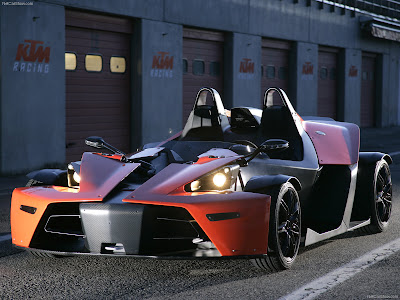
KTM X-Bow (2008)
The First Lamborghini

Monday, July 5, 2010
Devon GTX


Mercedes SLS AMG E-Cell Concept


Acceleration from zero to 100 km/h in 4 seconds. When it comes to dynamics, the electrically-powered SLS AMG makes a statement: the gullwing model accelerates from zero to 100 km/h in 4 seconds - which almost puts it on the same high level as the Mercedes SLS AMG with 6.3-litre V8 engine developing 420 kW (571 hp), which can accelerate to 100 km/h in 3.8 seconds. Further exciting touches are provided courtesy of the agile accelerator response and the straight-line performance: unlike the combustion engine, torque build-up with an electric motor is instantaneous - maximum torque is available virtually from a standstill. The spontaneous torque build-up and confident power delivery - which does not suffer from any interruption of tractive power - are combined with engine running characteristics which are totally free of vibration.
The Mercedes-Benz SLS AMG E-Cell drive incorporates a liquid-cooled high-voltage lithium-ion battery featuring a modular design with an energy content of 48 kWh and a capacity of 40 Ah. The maximum electric load potential of the battery, which consists of 324 lithium-ion polymer cells, is 480 kW, which is an absolute best value in the automotive sector. Another technical feature of this considerable performance is the intelligent parallel circuit of the individual battery modules - this also helps to maximise the safety, reliability and service life of the battery. The 400-volt battery is charged by means of targeted recuperation during braking whilst the car is being driven.
Bugatti Veyron Super Sport


Saturday, 2 pm - Bugatti's Pilote Officiel Pierre Henri Raphanel puts his helmet and gloves on, pulls the safety belts tight whilst the engineers check the car a very last time: tyre pressure, temperature, all systems go. Then the orange black Bugatti Veyron Super Sport crosses the light barrier, from now on the time will be taken, within one hour the car has to drive from South to North and then in the opposite direction. No one but the driver is allowed to touch the car during this time. The tension rises. A few minutes later we can hear from the left side the sound of a starting jumbo jet coming closer towards us. First we perceive the headlights of the Veyron, then we can recognize the shape of the car, a loud wooosh…. and Raphanel dashes in top speed past us. The GPS-tachometer stops at 427, 933 km/h. Now the same procedure from the opposite direction. This time the car reaches 434, 211 km/h. As average top speed the representatives of the "TÜV"and Guinness generate a value of 431, 072 km/h (268 mph). This even hit Bugatti's engineering team by surprise."We took it that we would reach an average value of 425 km/h," explains Bugatti's chief engineer Dr. Wolfgang Schreiber, "but the conditions today were perfect and allowed even more.The result is a car with a uniquely high performance of 1,200-hp (882 kW) offering experienced drivers a whole new dimension of excitement, with a maximum torque of 1,500 Newton metres and a limited top speed of 415 km/h (to protect the tyres) but, the technique of the Bugatti Veyron Super Sport is identical to the record car.
Ferrari 599 GTB Fiorano

Ferrari 599 GTB Fiorano
Production of this super car, Ferrari 599 GTB Fiorano started in 2007 and is a 2 seat model. Ferrari 599 debuted in 2006 at Geneva Motor Show and it was named after its engine which has 5999 Cm. The successor of the Ferrari 575M, Fiorano car has 6 speed semi automatic transmission, V12 engine under the hood and 611 Hp ,which makes it the most powerful super car produced by Ferrari road car and can touch 100 km/h in just 3,7 seconds and up to 200 km/h in just 11 seconds and the max speed is 320 km/h.
Compared with Ferrari 612,the wheelbase is shorter with 110 and the car is faster,with a weight of 1680 kg and will use F1-Trac, new traction system of Ferrari.
This super car will also appear in GrandTurismo series of video games,and can be play on Playstation or you can buy a real one at the price of 250000 USD.
Tuesday, June 29, 2010
2010 Tesla Roadster TAG Heuer

Monday, June 28, 2010
Bugatti Veyron
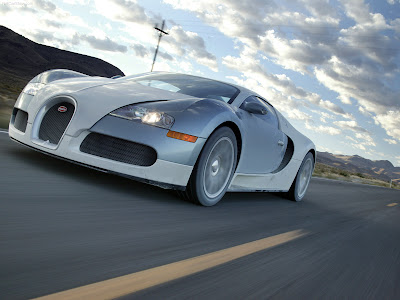
The new Bugatti Veyron 16.4 super sports car has set off a wave of exceptionally positive reactions from customers.It is therefore no wonder that the United States, without a doubt the most important market for the Bugatti Veyron 16.4, heads the list of Bugatti's contact points. Coming in after the United States are the most important European markets, Germany, Great Britain, Switzerland and France.
The Bugatti Veyron Cylinder capacity is 7,993 cm,Power output: 736 KW (1,001 hp) at 6,000 rpm,Max. torque: 1,250 Nm from 2,200 - 5,500 rpm and Gearbox: 7 Gear DSG
Performance
Top speed: 407 km/h
Acceleration:
+ 2.5 sec 0-100 km/h
+ 7.3 sec 0-200 km/h
+ 16.7 sec 0-300 km/h
Braking distance: 31.4 m 100-0 km/h
Gearbox shift time: < 150 ms
Tyres
Tyres, front: 265-680 ZR 500A (99Y) PAX System
Tyres, rear: 365-710 ZR 540A (108Y) PAX System
Fuel Consumption
In town: 40.4 l
Out of town: 14.7 l
Combined: 24.1 l
Thursday, June 24, 2010
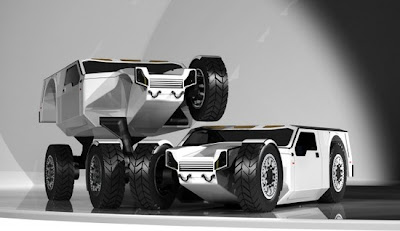
Shadow Hawk STV

Monday, June 21, 2010
Daihatsu UFE III Concept Car


The Daihatsu UFE-III is powered by a diminutive 660 cc Atkinson 3 cylinder engine and two electric motors. Add this to a 440 kg overall weight and it is a recipe for efficiency.The interior of the UFE III is set out in a 1+2 configuration, with two small seats crammed in behind the single central drivers seat. The UFE-III is controlled by steer-by-wire technology. The Daihatsu UFE III achieves category leading fuel economy of 72km/litre.
The Daihatsu UFE III features new 3-seater package with driver in front and two rear seats. Cd of 0.168 world’s lowest aerodynamic drag coefficient for this class of minivehicle, with polymer and aluminum ultra-light (440kg kerb weight) body and other measures to reduce rolling resistance. New-generation styling with a streamlined super aerodynamic shape, canopy door and pointed LED headlamps.
Sunday, June 20, 2010
Mercedes SLS AMG

The styling of the new Mercedes-Benz SLS AMG is not only very special because of the exclusive gullwing doors.The E-SELECT shift lever, whose styling recalls the thrust control of a jet, controls the AMG SPEEDSHIFT DCT 7-speed sports transmission. All the controls are made out of solid metal, with a high-sheen Silver Shadow surface.At the design stage great attention was paid to the widest possible opening angle - it is a full 70 degrees. Equally importantly, the distance between the open doors and the road surface is a generous 1.50 metres, while the entry aperture between the open doors and the upper edge of the door sills measures no less than 1.08 metres. The entrance height, i.e. the distance between the road surface and the upper edge of the door sills is a very low 45 centimetres.The feeling of comfortable spaciousness is in large measure due to the generous shoulder-room of 1483 millimetres and elbow room of no less than 1606 millimetres. The luggage compartment can hold up to 176 litres. The Mercedes-Benz SLS AMG is also breaking the mould when it comes to the body concept: for the first time, Mercedes-Benz and AMG are presenting a car with an aluminium chassis and body. Compared with the traditional steel design, this results in a significant weight saving, clearly illustrated in the DIN kerb weight of 1620 kilograms.45 percent of the intelligent, weight-optimised aluminium spaceframe is made out of aluminium sections, 31 percent out of aluminium sheet, 20 percent out of aluminium cast and 4 percent out of steel. Maximum occupant safety requires the use of ultra-high-strength, heat-formed steel in the A-pillars. The bodyshell weighs 241 kilograms - an absolute benchmark in the super sports car segment when compared with the peak output of 420 kW/571 hp.
The Mercedes-Benz SLS AMG consumes 13.2 litres per 100 kilometres (combined, provisional figure), earning it a place at the top of the competitor rankings. Efficiency-enhancing measures include the familiar AMG-exclusive, friction-optimised twin-wire-arc-sprayed coating on the cylinder walls as well as the on-demand, map-optimised oil supply and intelligent generator management: during the engine's overrun phases and braking, kinetic energy is used to charge the battery, rather than being wasted by simply generating heat.
Saturday, June 19, 2010
Chrysler ME412

Sunday, June 13, 2010
Ferrari 458 italia Nighthawk

The Ferrari 458 italia Nighthawk is operates on a 4.5 Liter V8 engine equipped with the traditional Ferrari flat crankshaft.It produces 570 HP at a rather high 9000 RPM which gives the future super car a power output of 127 HP/Liter. The Ferrari makes the 0 to 60 MPH sprint in just 3.4 seconds and won’t stop until it hits a top speed of 202 MPH.
Thursday, February 25, 2010
Ford Super Chief 2012

The Super Chief features Ford's new underride protection system called Blockerbeam that prevents smaller cars from riding up under the big rig during a crash while better dissipating the resulting energy between the two vehicles. The bold exteerior wrapped in a stainless style type skin is accompanied by perhaps the interior ever that features a glass roof bisected by aleather-wrapped grid and automated ottomans for weary rear passengers.
Running on Hydrogen, the supercharged V-10 engine provides upto 12 percent fuel economy improvement on an energy equivalent basis versus a non-supercharged gasoline V-10 and nearly miles per fill up.
Tuesday, September 8, 2009
2007 Aston Martin DB9

The future of Aston Martin is epitomised by the all-new DB9, a 2 sports car that sets new standards in its class due to its astonishing combination of agility, V12 power, smoothness, beautiful design and hand craftsmanship. Using a radical new aluminium-bonded body frame, the DB9 is one of the most sophisticated and technically advanced sports cars in the world. It is powered by the latest version of Aston Martin's 6.0-litre V12, producing 450bhp and a top speed of 186mph. Yet the DB9 is significant well beyond being a class-leading sports car. It is the beginning of a new era for Aston Martin. It is the first car to be hand-made at Aston Martin's new state-of-the-art facility in Gaydon, Warwickshire, where all future Aston Martin models will be developed and built. Sales of the model will start in Spring 2004, replacing the DB7, the most successful Aston Martin in history. 'Gaydon is the future of Aston Martin,' says Dr Ulrich Bez, CEO of Aston Martin. 'It combines cutting-edge high technology with hand-craftsmanship and tradition. It is probably the best facility of its type in the world, and the perfect showcase for how to design and build innovative sports and GT cars for the 21st Century. 'All cars built at Gaydon will be based on Aston Martin's new VH Vertical Horizontal platform. It's the first time in our history that we have had a totally flexible yet dedicated Aston Martin platform. The DB9 is the first car to use it making it the most important Aston Martin ever.' The body frame is the most structurally efficient in the world, taking into account strength, torsional rigidity and weight. It has double the rigidity of many rivals, as well as being lighter, resulting in superior handling and agility. All body panels are either aluminium or lightweight composites with magnesium being used on the steering column and inner door frames. Even the gear selector paddles are made from magnesium alloy. The total weight is 1710kgs, extremely light for a V12-powered prestige 2seater sports car with every imaginable luxury feature. This has a hugely beneficial effect on performance. Top speed of the manual is 186mph and 0-100 km/h (62mph) acceleration takes just 4.9 seconds. Other technologically radical features include a ZF 'drive-by-wire' six-speed automatic gearbox that dispenses with a traditional gear lever. Instead, the drive, park, neutral and reverse controls are selected by buttons. Touchtronic manual mode enables the driver to change gear using paddles mounted behind the steering wheel. The automatic gearchange has been tuned to provide the perfect balance between super-fast operation and comfortably smooth shifts. A conventional six-speed manual gearbox will also be offered. The agility of the car is boosted by the perfect 50:50 weight distribution. This has been achieved partly by putting the gearbox at the rear. A carbon fibre shaft, running in a cast aluminium tube, delivers torque from the engine to the gearbox. Handling is further improved by the light aluminium wishbone suspension and aluminium bodied dampers. The whole DB9 cabin is hand-finished in premium quality materials giving it a simple and functional feel. Aluminium is used in the interior, reflecting the most commonly used material in the structure and body. Even details such as the instrument dials are made from aluminium. Features include full leather Bridge of Weir upholstery of the highest quality and a state of the art music system specially developed for Aston Martin by British sound experts Linn. Among the many technological firsts is the 'message centre' in the dashboard. It is an organic electroluminescent display (OEL), as opposed to the more common LCD. OELs have a higher resolution and better contrast and are easier to read, especially when viewed at an angle. Of course, no Aston Martin would be an Aston Martin without a beautiful body. The DB9's is modern and clean but retains much of its heritage. It is a modern interpretation of a traditional Aston Martin, the successor to such benchmark designs as the DB4 and DB5. The aluminium bonnet is long and extends all the way to the car's leading edge. There is a minimum number of 'cut' or 'shut' lines, to aid styling simplicity and beauty. 'The DB9 has been designed as a sports car but with GT levels of comfort and cruising ability,' says Dr Bez. 'It is aimed at people who love driving but also enjoy exclusivity and style. 'It is the perfect vehicle to take you from London to the south of France, or to drive for the sheer exhilaration. It is fun and very focused on the driving experience, but also offers all the comforts you would expect from an Aston Martin grand tourer. 'This car is new from the ground up. We made sure that every solution was the correct one for the DB9. This is important for a car that we believe will lead the 2 sports car class for many years to come.' The DB9 manages to combine all facets of style, quality and useability of a traditional Aston Martin without relying on retrospective detail or design. It is a totally modern Aston Martin. Source - Ford / Aston Martin NEW DB9 - A LEADER IN SPORTS CAR TECHNOLOGY The new Aston Martin DB9 is one of the most sophisticated 2+2 sports cars available in the world today. The Aston Martin engineers' goal was to make a beautiful, distinctive car that was also outstandingly nimble and fast, and a car that was a worthy successor to the DB7 - the best selling Aston Martin in history. In every case, technology is used to make the car better and to make the driving experience more enjoyable. In most cases, the technology is invisible, always there, always helpful, never intrusive. Light and immensely strong aluminium frame In a long list of technological innovations, the most important is the bonded aluminium frame. Aston Martin believes it is the most structurally efficient body frame in the car industry. The new Aston Martin VH (vertical horizontal) aluminium structure gives immense benefits. It is very light, aiding performance, handling, economy and durability. It is also enormously strong. Despite being 25 percent lighter than the DB7 bodyshell, the DB9 structure has more than double the torsional rigidity. This is the car's backbone, the skeleton to which all the mechanical components are either directly or indirectly mounted. Drawing on the experience and technology pioneered in the Vanquish, the DB9's frame is made entirely from aluminium. Die-cast, extruded and stamped aluminium components are bonded using immensely strong adhesives, supplemented by mechanical fixing using self-piercing rivets. 'It is far superior to the conventional steel saloon-based floorpan often used by high-value brands,' says Aston Martin DB9 Chief Programme Engineer David King. 'The torsional rigidity of a car is a key factor in driving enjoyment and good handling. Any flexibility of the body compromises the performance of the suspension, delays vehicle response and corrupts feedback to the driver.' The tub is made in aluminium and the body panels are then fitted, again using adhesives, in the advanced body assembly area at Aston Martin's new Gaydon facility. This adhesive is applied by a robot - the only one at Aston Martin. Computer controlled hot-air curing ensures the highest standards of accuracy and repeatability. The bonding has enormously high stiffness, so that shakes and rattles are obliterated. Bonding also has excellent durability offering better stress distribution than welding - which is more prone to crack. The process is also used in the aircraft industry and Formula One. There are also advances in the welding procedure. On the DB9, the upper and lower C-pillars are joined by advanced ultrasonic welding. It works by using a vibrating probe, called a sonotrode, which oscillates at 20,000 Hz. This high frequency of vibration agitates the molecules of the two aluminium panels to be joined, allowing them to form a molecular bond. Because the bond takes place at a molecular level, it is 90 percent stronger than a conventional spot weld. It also requires only five percent of the energy of conventional welding, and as it generates no heat, there is no contamination or change in the characteristics or dimensions of the metal. Aston Martin is the first car company in the world to use this technique. Lightweight frame helps performance and handling In addition to the aluminium frame, other lightweight or high-technology materials are used extensively. The bonnet, roof and rear wings are aluminium. The front wings and bootlid are composite. Cast aluminium is used in the windscreen surround, another industry first. Magnesium alloy, which is even lighter than aluminium, is used in the steering column assembly and inner door frames. The driveshaft is made from carbon fibre. It is part of the torque tube that rigidly connects the front engine to the rear gearbox. This arrangement helps the DB9 achieve perfect 50:50 weight distribution, further improving handling. Lightweight suspension, brakes and wheels The DB9 uses all-round independent double-wishbone suspension. As the body frame is brand new, the chassis designers were able to start from scratch - rather than be forced to develop a suspension for an adapted saloon car platform. The front suspension is mounted on a cast aluminium subframe. At the rear, another subframe carries the rear suspension as well as the rear transaxle. Forged aluminium wishbones are used front and rear, as are aluminium-bodied dampers. This is rare, even on top-end sports and GT cars. The steering rack is mounted ahead of the front wheels, which provides better control under extreme steering loads and heavy braking. Magnesium alloy is used in the construction of the steering column.Even the wheels have been specially designed to save weight. The 19-inch alloys are made using flow forming rather than casting. This saves about 1kg per wheel, benefiting unsprung mass, overall vehicle weight, and reducing rotational inertia. The tyres have been specially developed by Bridgestone. On a 180+mph performance car, superb brakes are essential. The large discs are ventilated and grooved, rather than cross-drilled. 'Grooving is more efficient than cross drilling,' says David King. 'The pads are kept cleaner and work more effectively. Also, brake pad dust can block cross-drilled discs, which reduces braking performance.' The callipers are made from a single casting, rather than being fabricated in two halves and then bolted together. This increases strength and rigidity and gives superior braking performance at high speeds. 'This project was such a pleasure to work on,' comments King. 'We really could start from scratch in just about every area which rarely happens in the car business. We were not fighting compromises, such as having to adapt a saloon car component into a sports car.' Braking is improved by Electronic Brakeforce Distribution (EBD), which is computer controlled to optimise the front-to-rear brake balance, and by Brake Assist - in which the car's electronics detect when the driver wants to emergency brake and automatically applies maximum braking force, cutting stopping distance. There's also the latest anti-lock (ABS) system, which prevents the car skidding or sliding out of control. LED tail lamps improve rear lighting performance and also react quicker - in braking, for example - than conventional incandescent bulbs. Their design in the DB9 is novel: the tail and brake lamps project through a reflector, which disperses the rays more evenly, further improving lighting performance. This also gets rid of the little 'hot spots' that make up most LED tail lamps. Rather than a series of clearly visible dots, the light is one solid block. Dynamic Stability Control (DSC) is standard. DSC is an advanced electronic control system that continually analyses wheel speeds, steering angle and yaw rate. It reduces the risk of skids by automatically applying braking to individual wheels, or reducing engine torque. The DB9's entire electrical architecture is state-of-the-art, the result of a partnership with fellow Premier Automotive Group member Volvo, which uses multiplex electrical systems in its product range. 'It's a high volume but very advanced system, exactly what we wanted,' says Aston Martin's Chief Engineer for Electrical and Electronics Sean Morris. 'Every module on the car talks to every other module.' The air conditioning and climate control system is one of the most compact and efficient units in production. Instrument pack - mixed with high-tech organic electroluminescent display The instrument pack is particularly attractive and innovative and all dials are made from aluminium. Microperforations allow the warning lights to illuminate through the aluminium. The rev counter runs anti-clockwise to maximise the visible area for the central electronic display, in the main instrument cluster. It's also a nice reminder of earlier Aston Martin models such as the Atom and the DB2. There is no conventional red line on the tachometer. A red warning symbol will be displayed when maximum revs are reached but - thanks to the high-tech electronics - the 'red line' varies, depending on the engine's mileage, how recently the engine has been started, and ambient temperature. The electronic message displays in the main instrument cluster, and in the centre console, are organic electroluminescent displays (OEL). This is another car industry first. There are many benefits to OELs compared with conventional LCDs, including higher resolution and greater contrast, and improved clarity, particularly when viewed from an angle. The ICE system is state of the art. It's been developed by Scottish-based Hi Fi experts Linn, and includes its own amplifier and speakers that are specially designed for the DB9. It also benefits from the DB9's high-quality fibre optic electronics, which pass signals with total clarity. The top-of-the-range 950W Linn Hi Fi system uses 10 speakers and a 200W sub-woofer controlled by an in-built accelerometer that even compensates for changes of pressure in the car's interior. 'The goal was to make the finest ICE system of any car in the world,' says Sean Morris, 'and I think we have succeeded.' Aston Martin wanted to make the DB9 one of the safest sports cars in the world. For this, as with the electrical architecture, Aston Martin's engineers turned to Volvo for assistance. 'Volvo is renowned as the automotive safety leader,' says Chief Programme Engineer David King. 'It was the perfect partner to assist in delivering the DB9's outstanding safety performance. 'This car was developed in-house, by Aston Martin's small but highly skilled engineering team,' says King. 'Yet there were some areas where it made sense to draw on the expertise of other members of the Premier Automotive Group. 'Safety is one example. We are very fortunate to have Volvo as a partner. This partnership has given us access to the latest safety technologies, best-practice design guidelines and advanced computer aided engineering.' All crash testing was done by Volvo in its state-of-the-art safety centre in Sweden. The VH platform was designed to provide a supremely robust passenger cell that cocoons its occupants. The cell is protected at the front and rear by extruded aluminium crumple zones. Dual-stage driver and passenger airbags, and seat-mounted side airbags, offer further protection, as do seat belt pretensioners. 'When you're attempting to build the world's greatest 2+2 sports car - and that's certainly the goal for the DB9 - there really is no substitute for a V12,' says Aston Martin's Chief Powertrain Engineer Brian Fitzsimons. 'Aston Martin's V12 is acknowledged as one of the best in the world, so was a very good starting point.' The engine is developed from the V12 used in the Vanquish. The advanced quad-cam 48-valve engine has been designed by Aston Martin engineers in partnership with Ford's RVT (Research and Vehicle Technology), and is unique to Aston Martin. The crankshaft is new, as are the camshafts, inlet and exhaust manifolds, the lubrication system and engine management. The result is more low-down torque and a more seamless power delivery. Maximum power is 450bhp and maximum torque 570Nm. Even more impressive, 80 percent of that maximum torque is available at only 1500rpm. 'This car will overtake in any gear, at any revs, more or less any time. It really is that good,' says Fitzsimons. Comparing the Vanquish's engine to that of the DB9, Fitzsimons comments: 'The Vanquish offers more ultimate performance, the DB9 has more torque over a wider rev range,' says Fitzsimons. In the new DB9, the V12 - which is a significant 11.8kgs (26lb) lighter than the Vanquish V12 - has been fitted as far back and as low as possible, to assist agility and handling. This helps the DB9 achieve its perfect 50:50 weight distribution. Engine note is also very important to the driving experience. 'The Aston V12 engine has been described as having the best sound in the world,' says Brian Fitzsimons. 'We spent a great deal of time getting the 'music' of the DB9 just right.' The DB9 is fitted with a rear transaxle to help achieve the ideal 50:50 weight distribution. The front mid-mounted engine is connected to the rear gearbox by a cast aluminium torque tube, inside which is a carbon fibre drive shaft. The use of carbon fibre prevents any flex and ensures low rotational inertia, improving response and cutting both noise and vibration. Two transmissions are offered: a six-speed ZF automatic gearbox and a new six-speed Graziano manual gearbox. The ZF automatic used in the Aston Martin DB9 is particularly innovative. The DB9 is one of the first cars in the world to use a shift-by-wire automatic gearchange. The conventional PRNDL gear lever has been replaced by a system of buttons that select park, reverse, drive or neutral. 'It's easy to use and gets rid of the clutter associated with the automatic gear lever on the centre console,' says David King. Those choosing the ZF automatic can drive the car in full auto mode, or can change gear manually using the paddle shifts. The paddles are made from lightweight magnesium and are directly behind the steering wheel, at the 10-to-two position. They allow instant Touchtronic gearchanging. A great deal of time has been spent ensuring that the new Graziano manual gearbox has a smooth and fast shift action. 'It is one of the best manual gearchanges in the world,' says Chief Programme Engineer David King. 'Driving enjoyment is a very important quality of the DB9, and part of this is a superb gear change action.' The manual uses a twin-plate clutch, compared with the DB7 Vantage's single plate unit. It is more compact, has lower rotational inertia and is more robust. The clutch effort is also reduced. The 'swan wing' doors are unique and will become one of the car's trademarks. They open out and up (by 12 degrees) making for easier access, especially for the driver's feet into the footwell. This also improves clearance for the driver's (or passenger's) head between side glass and roof, further easing access. The 12-degree angle also means there is less chance of the doors scuffing high pavements. As they are angled, the doors are easier to close: they shut partly under their own weight, rather than relying on the driver having to slam them. Beyond 20 degrees opening angle, there is also infinite door checking. This means that the door will stop and hold at whatever position the driver (or passenger) chooses. The door handles feature LEDs that illuminate when the car is unlocked, allowing the handles to be located easily in the dark. The exterior handles lie flush with the door, to improve appearance and aerodynamics. The new DB9 has enjoyed the most thorough testing programme of any new Aston Martin model. Ninety-three prototypes were built and tested in locations as diverse as Nardo in Italy, Death Valley in the USA, and inside the Arctic Circle in Sweden, as well as in laboratories around the world. As well as using the Cranfield University's state-of-the-art 40 percent model wind tunnel, Aston Martin also used Ford's Environmental Test Laboratory in Dunton, which features one of the most advanced climactic wind tunnels in the world. Other testing took place at Volvo's world-renowned crash test safety centre in Sweden, and at the vast and superbly equipped Ford test track in Lommel, Belgium. 'Producing the DB9 in small volumes allows us to retain our handcrafting skills,' says Aston Martin Product Development Director Jeremy Main. 'It also allows us to use bespoke engineering solutions, such as the bonded aluminium structure and the aluminium instrument pack and the Linn ICE system. You just can't do this in mass production. 'The problem with small volumes, though, is that you typically have to use other manufacturers' components, and that usually compromises your car. But there are technologies that need high volume processes - ABS and electrical architecture for example - and we are lucky to be able to choose the best available components and then modify and adjust them to suit our needs. 'We've been fortunate in not having to compromise. Higher volume systems that we are using - such as the electrics and air conditioning - have actually made the car better.'There has probably never been a 2+2 sports car that started with fewer compromises. The result is that the DB9 is a pure, beautifully honed sports machine.' Says Dr Ulrich Bez, CEO of Aston Martin: 'We're confident that it is the finest 2+2 sports car in the world, and will continue the Aston Martin success story that is one of the highlights of the British motor industry in recent years.
Subscribe to:
Posts (Atom)


