Showing posts with label RALLY. Show all posts

Sunday, August 1, 2010

Indian Flag Car

Indian Flag Car 1
Here's the INDIAN FLAG CAR. The Indian Formula One Racing team Force India, while yet to get of the bottom of the pile, came close to winning their first F1 points in Shanghai last week. The team sports the Indian flag as its team colors and has attracted sponsorship from Indian companies Kingfisher, ICICI Bank, Reliance Industries and Kanyan Capital. Force India was formed after Indian businessmen Vijay Mallya and Michiel Mol bought the Spyker F1 team for US$115 million. The team races its own designed cars, powered by Mercedes-Benz, and was able to rise from 18th to as high as sixth with just 5 laps to go.

With Delhi being added to the Grand Prix circuit in 2011, Force India are learning and may well be a team to reckon with by the time the Delhi Grand Prix arrives. The team has just signed a five year agreement with Mercedes for engines, and a partisan Indian crowd in Delhi may make a large impact at the event.

The participation in, and rise to prominence of an Indian team in F1 is in marked contrast to China, which despite having hosted the F1 in Shanghai for the past few years, does not field a competing team. This is somewhat surprising, given that both China and India are poised to be the world’s largest auto markets in the next two to three years, with more vehicles having been sold last year in China than in the United States for the first time.The Chinese logic for hosting the event, but not participating, seems a little skewed. The Chinese government pays Formula One about US$50million each year to host the Shanghai event, yet the country has not followed that up with a competing presence, cars or drivers, in the rest of the series. The prices to attend the Shanghai event also seem bizarre if China wants to use it to promote its auto industry.

Shanghai wages averaging at about US$500 a month, that’s equivalent to the price of the cheapest ticket on offer for the Shanghai F1. You would need to charge US$4,000 to attend the Indianapolis 500 in the United States to achieve a similar disparity. So while Force India prepares the world for Indian cars and trucks Tata having already acquired global brands Jaguar and Land Rover, and about to launch Tata as a brand name in Europe and the United States through the Nano and its trucking division – the Chinese are just not getting on board. It’s a curious state of affairs, especially since F1 have apparently re-signed with Shanghai to host the event for another seven years. US$50 million seems a lot to pay for a one off annual event that the local Chinese cannot generally afford to attend, in which no Chinese team participates, in a 17 race series which is broadcast globally and attracts hundreds of millions of viewers.

Force India meanwhile are pushing forward at the top end the concept of Indian vehicles as reliable, and developing India as a manufacturing brand in auto that will assist its national auto manufacturers integrate into and penetrate international markets.

Wednesday, July 21, 2010

McLaren F1 (1993)

McLaren F1 (1993)
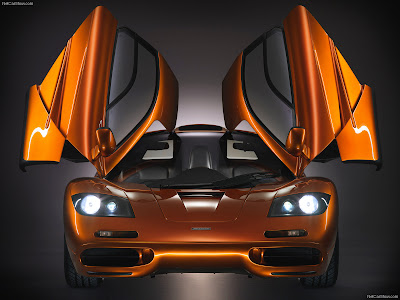
The McLaren F1 is a sports car designed and manufactured by Gordon Murray and McLaren Automotive. On March 31, 1998, it set the record for the fastest production car in the world, 240 mph (391 km/h). As of April 2009, the McLaren F1 is succeeded by three faster cars in sheer top speed, but is still the fastest naturally aspirated production car.It features a powerful engine and is somewhat track oriented, but not to the degree that it compromises everyday usability and comfort.Turbochargers and superchargers increase power but they increase complexity and can decrease reliability as well as introducing an additional aspect of latency and loss of feedback, the ability of the driver to maintain maximum control of the engine is thus decreased. Murray initially approached Honda for an NA powerplant with 550 bhp (410 kW; 560 PS), 600 mm (23.6 in) block length and a total weight of 250 kg (551 lb), it should be derived from the Formula One powerplant in the then-dominating McLaren/Honda cars.

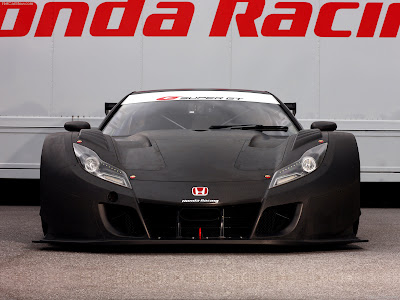
Honda HSV-010 GT

Honda HSV-010 GT
Engine

   Engine name: HR10EG

Configuration: Liquid-cooled, naturally aspirated, longitudinal V8, V angle: 90°, Valve train: Gear-driven DOHC - 2 intake and 2 exhaust valves per cylinder, Displacement: 3397 cm3, Bore x stroke: 93.0 x 62.5 mm, Maximum output: 500 PS (370 KW), Maximum torque: 392 Nm,Throttle control system: Mechanical, Fuel supply system: Programmed fuel injection system (Honda PGM-FI), Fuel: Lead-free premium gasoline, Lubrication: Dry sump.

Audi to Show Seven Customized A1 Models at Worthersee

Audi to Show Seven Customized A1 Models at Wörthersee
This year's edition of the Worthersee GTI Tour that takes place in Reifnitz, Austria, on May 12 will see Audi showcasing seven custom versions of its new A1 premium supermini, including a model sporting an "FC Bayern" look, taxi and police variants. The other four custom A1s are a "Hot Rod" version with a matt-finish look, steel wheels with white-wall tires and extremely low ride height thanks to the air suspension, one fitted with a "competition kit" that pays homage to Audi rally vehicles from the 1980s, the "Wasserwacht" model that's dedicated to the local water rescue service and a "Fashion" edition. "The Audi A1 fits in with the GTI meet because customization has always been a central topic for the Audi fans here at the Worthersee and will also play a special role for A1 customers," says the Head of Audi Design, Stefan Sielaff, who was responsible for the creation of the special edition models. The seven special A1s will be joined at Audi's Worthersee stand by an array of models including the new Audi R8 GT, an Ice Silver A8, the facelifted TT Roadster and the TT Coupe and the new RS5 Coupe.

Monday, July 5, 2010

Devon GTX

Devon GTXDevon GTXDevon GTX
The new 2010 Devon GTX blends athletic strength with uncompromising refinement thanks to what is perhaps the most powerful naturally aspirated production car powertrain system in the industry. The Devon GTX is equipped with an 8.4-liter (510 cubic inches) V-10 engine that produces 650 horsepower (484.7 kW) at 6100 rpm. The V-10 engine is mated with a track-proven six-speed manual transmission.The end result is a propulsion system that rivals - and in most cases surpasses - the most powerful offerings in the world.The air induction box receives combustion air via snorkel tubes from the super coupe's low-mounted center air intake in the front portion of the vehicle. The induction box provides minimal inlet restriction at peak airflow - a key enabler the engine's exceptional power.The dual exhaust system is initiated with lightweight 5-into-1 super-tuned long tube headers leading into 2.5-inch diameter pipes that help enable low back pressure and high flow. The system is made of stainless steel, which leads to chrome, 3.75-inch beveled (concave) tips exiting the rear center portion of the vehicle.The transmission on the Devon GTX incorporates a host of applications to ensure effective transfer of the 8.4-liter engine's exceptional power and torque while delivering high-performance, fun-to-drive shifting characteristics. The end result: is short, crisp shift throws; smooth gear synchronization, and overall improved shift feel with little or no vibration. The transmission boasts wider gears for increased torque-handling capability; a six-gear synchronizer system for exceptional shift feel and reduced efforts; double-cone reverse gear synchronizer for eased "R" selection; strengthened housing for minimal "flex" and improved shifting; and a dual mass flywheel with twin-disc clutch.

Sunday, July 4, 2010

Citroen DS3 R3

Citroen DS3 R3
The Citroën DS3 R3 has benefitted from the extensive expertise acquired by Citroën Racing through its involvement in the World Rally Championship.Under the bonnet lies a four-cylinder 1.6-litre THP (high pressure turbo) engine, which has been developed using the PSA production engine. Specific racing parts (air box, camshaft, pistons, connecting rods, exhaust and turbo systems, electronic unit, etc.) have been deployed to boost the car's power to 210bhp.The 1.6-litre THP (high pressure turbo) engine is very closely related to the production model used throughout the PSA Group. Fitted with a regulation-compliant 29mm turbo flange, it develops 210bhp of power and generates a torque of 350Nm (with commercially available fuel). This second value improves traction and delivers excellent versatility at all engine speeds.All of the drivers agreed that the car was easy to drive and highlighted three strengths: the torque of the 1.6-litre engine, the semi-automatic gearbox and the suspension.

Tuesday, June 29, 2010

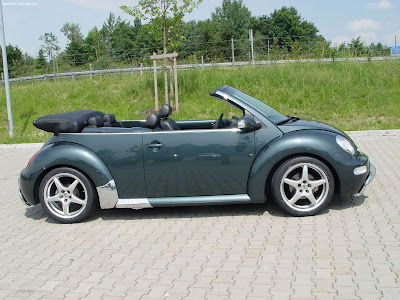
ABT VW New Beetle Cabriolet

ABT VW New Beetle CabrioletABT VW New Beetle Cabriolet


The ABT VW New Beetle Cabriolet including two types of back-silencers, an aluminium gear lever knob, aluminium pedals, stainless steel running boards, as well as a set of floormats displaying the Abt Sportsline logo. Additionally, a New Beetle owner can choose between 14 wheels, one of them being the brand-new Z5 wheel (8 x 18") presented on the IAA motor show.The 2.0-litre engine receives a power plus to ca. 105 kW (143 hp) thanks to capacity enhancement by 200 cubic centimetres, a customized Abt crankshaft, special pistons, Abt camschafts, a cylinder head modification, a mid-silencer, optimised air ducting as well as changes to the electronic engine management. Abt expertise in the ECU field ensures an increase in the 1.8-litre turbo-engine from 110 kW (150 hp) to 142 kW (193 hp). For the 1.9-litre TDI, Abt provides an increase from 66 kW (90 hp) to 85 kW (112 hp).A front grill, chrome fog headlamp frame, headlamp visor and the matching V-rims (7.5 x 17 inch) rounds off the New Beetle body kit from the House of Abt.A very special example of the New Beetle caused a sensation in German rallying: Together with natural gas supplier Thyssengas, Abt enters a Beetle in the German Rally Challenge series and the German Rally Championship. The highlight: The 230 hp model uses natural gas instead of traditional fuel.

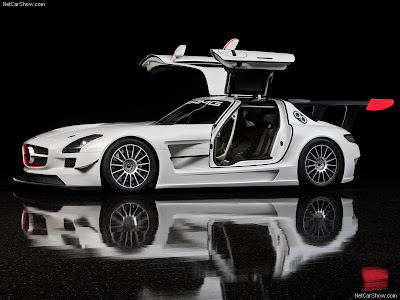
2011 Mercedes SLS AMG GT3

2011 Mercedes SLS AMG GT3
The extra special Mercedes Benz SLS AMG will make its race track debut in 2011. The Car features clean design and breathtaking form of the Mercedes Benz SLS AMG. The 2011 Mercedes SLS AMG GT3 race car boasts a new front skirt with enlarged air intakes. The wide opening beneath the characteristic radiator grill bearing the large Mercedes star and the wing shaped horizontal fins supplies air to the engine oil cooler and brake discs. The same function is served by the two intakes below the vertical bi-xenon headlamps. Downforce on the front axle is provided courtesy of four externally mounted side flics, as well as a carbon front splitter; it runs directly into the smooth underbody panel. The hood features a central opening for the extraction of heat from the engine, while side openings in the front fenders facilitate air flow through the wheel arches. The fenders have been widened front and rear to accommodate the large racing tires with a breadth of 78.3 inches, the GT3 bodyshell is a good 2 inches wider than the series production Mercedes-Benz SLS AMG. The new sills feature openings for cooling the rear brakes, with the smooth underbody visible along the underside of the sills. The 31.7 gallon fuel tank is located centrally behind the driver. The AMG 6.3 liter V8 engine is virtually identical to that of the series production vehicle. Due to its low weight, the acceleration figures for the GT3  3.7 seconds for the sprint from 0 to 60 mph. Depending on gear ratio, the top speed is more than 186 mph. The AMG 6.3 liter V8 engine uses dry sump lubrication in the racing vehicle, too. All four corners feature brake discs in motorsport-tested composite technology. Gray cast iron axial and radial floating discs are fixed to an aluminum hat via stainless steel composite elements. This sophisticated technology enables perfect heat dissipation and thus reliable stability. The Mercedes-Benz SLS AMG GT3 is also equipped with precisely calculated cooling channels openings in the front skirt and ahead of the rear wheels direct cool airflow over the brake discs. All four brake discs are ventilated, slotted and drilled. Six pot fixed calipers on the front axle and four pot fixed calipers at the rear, with the AMG logo in white, provide plenty of brake pad surface. An anti-lock brake system with special race track settings is fitted as standard. A steering wheel with a diameter of 13 inches facilitates perfect vehicle control. On opening the gullwing doors, the Mercedes-Benz SLS AMG GT3 displays a functional interior with a distinctly race car feel.

Monday, June 28, 2010

Bugatti Veyron Centenaire

Bugatti Veyron Centenaire


The Bugatti Veyron Centenaire is a very expensive and good looking car in the world .The Type 35 Grand Prix was by far the most successful racing model. The unmistakable radiator grille and eight-spoke aluminium wheels of the Type 35 have become defining features of the Bugatti automobile. In its day, the Grand Prix was also well ahead of its time in terms of engineering ingenuity.The Grand Prix's brake drums were integrally fitted into its lightweight aluminium wheels. Unfastening the central wheel nut allowed the wheel to be easily removed within a matter of seconds and the brake to be exposed. This was a crucial advantage at the pit stop.Supposedly called the Centenaire edition, reports suggest the special Veyron an increased power rating – word on the street has always been that the Veyron's quad-turbo W16 was always capable of more than the already astronomic 1000 horsepower rating it got – up to some 1350 horses, good enough to boost the top end up to 420 km/h (261 miles-per-hour) from the current benchmark of 400 km/h (253 mph). Special paint schemes and trim pieces will surely be part of the mix as well, but hitting the Willard Scott mark may prove enough to warrant a more substantial birthday gift if the rumors are to be believed.

Bugatti Galibier

Bugatti GalibierBugatti GalibierBugatti Galibier


The Bugatti Galibier's design masters the challenge of uniting sportiness with the comfort and elegance of a modern four-door saloon. The basic architecture picks up on the torpedo-like character of the Type 35, which was already revived in the Bugatti Veyron, and reinterprets it.The Bugatti Galibier i16-cylinder,8-litre engine with twostage supercharging and features 64 valves, generating 1001 horsepower at 6000 rpm.The Bugatti Galibier engine special is that it was developed as a flex-fuel engine and can optional be run on ethanol. Four-wheel drive, specially developed ceramic brakes and a new suspension design enable the agile, always-sure handling of a saloon of this size. The engine draws on its 8-litre displacement to deliver a maximum torque of 1250 Newton-metres between 2200 and 5500 rpm. Apply the brakes at speeds above 200 km/h, and the rear wing acts as an airbrake, positioning itself at an angle of 113 degrees in less than 0.4 seconds, augmenting the Bugatti Veyron's already impressive stopping power. The airbrake increases negative lift at the rear of the car to 300 kg, enhancing the braking torque on the rear axle. At 400 km/h, emergency braking will bring the sports car to a complete halt in less than 10 seconds.This striking and unparalleled harmony between luxury and sportiness is complemented by alloy-coloured details in the form of the chromed Bugatti grill and door-mirrors, as well as polished wheel surfaces and roof-rails. All-black front lights, air intakes, filler caps and door-handles naturally heighten the stunning effect of the racing-blue brake callipers.

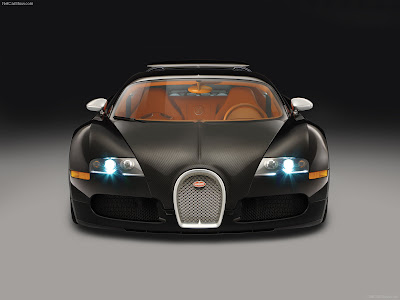
Bugatti Veyron Sang Noir

Bugatti Veyron Sang NoirBugatti Veyron Sang NoirBugatti Veyron Sang Noir


The Bugatti Veyron Sang Noir is a special edition, created for the true automotive connoisseur.Similar to its thoroughbred predecessor, the Type 57S Atlantic, the Bugatti Veyron Sang Noir exposes a raptor-like DNA that is reflected throughout the entire model history of the marque..The Bugatti Veyron Sang Noir is a special edition, created for the true automotive connoisseur.The 16-cylinder "W" configuration engine is fed by four turbochargers and features 64 valves, generating 1001 horsepower at 6000 rpm. The engine draws on its 8-litre displacement to deliver a maximum torque of 1250 Newton-metres between 2200 and 5500 rpm. Apply the brakes at speeds above 200 km/h, and the rear wing acts as an airbrake, positioning itself at an angle of 113 degrees in less than 0.4 seconds, augmenting the Bugatti Veyron's already impressive stopping power. The airbrake increases negative lift at the rear of the car to 300 kg, enhancing the braking torque on the rear axle. At 400 km/h, emergency braking will bring the sports car to a complete halt in less than 10 seconds.This striking and unparalleled harmony between luxury and sportiness is complemented by alloy-coloured details in the form of the chromed Bugatti grill and door-mirrors, as well as polished wheel surfaces and roof-rails. All-black front lights, air intakes, filler caps and door-handles naturally heighten the stunning effect of the racing-blue brake callipers.

Tuesday, June 22, 2010

Wartburg Car

Wartburg Car
Wartburg Car
The Wartburg car had a more powerful version of the 3 cylinder 2-stroke engine driving the front wheels and a completely new body. Exports to West Germany started in 1958, and by the early 60s the car was exported to many countries in the world, including the US. The 311 model was manufactured in a number of variations, such as pick-up, station wagon, and a 2-seater roadster. Many Wartburgs are still used as rally racing cars. The engine was enlarged to 992 cc in 1962 and a completely new body was manufactured after 1966. Also in 1966 the gearbox gained synchromesh on all speeds. The new car, the 353 was based on a Polish-built Warszawa 210 and remained in production for decades with minor modifications. The two-stroke engine was replaced by a 1300 cc four stroke Volkswagen engine in 1988. The sports car Melkus RS 1000 used a mid-mounted 3-cylinder 2-stroke engine from the Wartburg 353.

Sunday, June 20, 2010

Porsche 911 GT3

Porsche 911 GT3


 The new GT3 is naturally built for superior safety even at very high speeds.The six-speed manual gearbox now provides shorter transmission ratio increments, taking the extended rev-range of the GT3 engine into account. On the road or track, this means acceleration from 0-62 mph (0-100 km/h) in just 4.3 seconds, with the GT3 charging on to 99 mph (160 km/h) in 8.7 seconds. Top speed is 310 km/h or 193 mph.This is aided in particular by the car's low weight of 3076 pounds (1395 kilos), the dedicated tuning of the PASM, the increased performance of the brakes, and the new sport tires. On the track this means even faster lap times, while in everyday motoring this equates to supreme active safety.

IMPROVED AERODYNAMIC BALANCE

Developing a specific output of 115.3 bhp per liter, this power unit ranks at the top of all normally-aspirated engines in cars currently homologated for road use. This performance is the result of a consistent, far-reaching process of ongoing development seeking to increase engine output without increasing the size of the engine itself. Displacing exactly 3.6 liters, the six-cylinder featured in the new Porsche 911 GT3 capitalizes on the displacement limit allowed in its category of motorsport, developing 415 bhp at 7600 rpm and reaching a maximum engine speed of 8400 revs. Peak torque, in turn, is 300 lb-ft at 5500 rpm.

By comparison, the former Porsche 911 GT3 developed maximum output of 381 bhp at 7400 rpm and peak torque of 284 lb-ft at 5000 rpm.

The big advantage of the new system is that intake camshaft adjustment is now up from 45-degrees to 52-degrees, further enhancing the engine's qualities in terms of output, torque and emission management. The intake camshafts have also been revised, with intake valve stroke increased by 0.4 millimeters over the previous model to 12.7mm

Ferrari 430 Scuderia

Ferrari 430 Scuderia


T he new model is a special series based on the Ferrari 430 Scuderia .The 430 Scuderia is a truly high-performance 2-seater berlinetta which demonstrates how Ferrari's Formula 1 know-how is carried across to its production cars.The Ferrari 430 Scuderia car can count on an extremely low weight-to-power ratio of just 2.45 kg per bhp thanks to a low dry weight of just 2755 lb - 220 lb less than the  Ferrari 430 Scuderia - and to the naturally-aspirated 4308cc V8's 510 bhp at 8500 rpm.There is the latest software - F1 Superfast - which reduces gearchange times to just 60 milliseconds, and new traction control which, for the first time, combines the E-Diff electronic differential and the F1-Trac traction and stability control in a single integrated system.

Pininfarina Sintesi

Pininfarina Sintesi


Pininfarina Sintesi


Pininfarina Sintesi


The basic theme of Pininfarina Sintesi is a continuous looped surface that, starting from the front wing, stretches along the side of the car, naturally blends into the rear fender and then turns around the side window to dive back under the front wing. Like a Moebius ring, uniting the inside and outside of the car. The four doors open independently. The aerodynamic under body allow to reach an exc6ellent CX value of 0,272 The rear lights incorporate not only the newest LED Osram technology but also cameras and sensors and visually connects the rear to the side by underlining the central axis. The instrument panel of Pininfarina Sintesi is designed as one integrated semi-transparent piece, deriving its richness from a sophisticated play of light that serves as a visual feedback for the different functions. A kind of network capable of rendering "transparent" the communication systems of individual cars and guaranteeing safe, efficient mobility. The user interface will be highly intuitive, it will use a language - created by Pi Shurlok - made of lights and colors capable of being immediately understood by the driver with no signs or icons in the way. All the information currently provided by the infrastructures (traffic lights, road signals) will be displayed inside the vehicle.Pininfarina Sintesi will communicate with other cars and will be able to select the best route.

Saturday, June 19, 2010

Jaquar XK

Jaquar XK
The new XK delivers more power, more performance and more technology – without compromise.All-new AJ-V8 Gen III direct-injection engines are the most advanced and efficient engines Jaguar has ever produced: 5.0-litre naturally aspirated AJ-V8 Gen III engine delivers 385PS (385bhp SAE), 515Nm of torque and propels XK to 60mph in just 5.2 seconds.The New Jaquar XK is Improved CO 2 emissions performance (Euro Stage V compliant two years ahead of legislative requirement) and fuel economy comparable to the less powerful 4.2-litre engines they replace.Jaquar XK With the introduction of these all-new 5.0-litre direct-injection V8 engines comes a new level of performance for the XK, with improved acceleration from standstill and stunning in-gear acceleration times. All models are electronically limited to a maximum speed of 155mph (250kph), but the 0-60mph sprint for naturally aspirated coupe models is now 5.2 seconds (previously 5.9 seconds), while for the supercharged XKR coupe, 0-60mph is 4.6 seconds (previously 4.9 seconds).

In-gear times are equally impressive, with the naturally aspirated XK accelerating from 50-70mph in just 2.5 seconds.

Tuesday, June 1, 2010

Seat Ibiza SC Sport Limited Edition

Seat Ibiza SC Sport Limited Edition,front


Seat, Ibiza, SC, Sport, Limited, Edition, front


Seat Ibiza SC Sport Limited


Seat has announced the availability of a new Seat Ibiza SC Sport Edition for the German market. The Seat Ibiza SC Sport Edition comes in a Lamborghini-like “Lumina Orange” finish and only with the not-so sporty 105HP 1.6-liter petrol engine. The production run will be limited to 300 cars.


The special ness of the car comes from an extra equipment package that adds value via numerous features.


On the outside, the Seat Ibiza SC Sport Edition is distinguished by the 17-inch alloy wheels finished in black and shod in beefier sport tires, an aerodynamic kit with a new front bumper, side skirts, roof spoiler and a unique rear bumper housing air vents on both corners, a diffuser and two tail pipes mounted centrally.


In addition, the car's rooftop and exterior mirrors are finished in black.


The two-tone color theme is continued inside as the air-vent rings, gearbox knob, door panel trims as well as the seams on the thick-rimmed steering wheel and sport seats are all finished in orange. The aluminum pedal set and additional standard features such as rain sensors and park assist system complete the package.


The new Ibiza SC Sport Limited is priced at €20,620.

Monday, April 19, 2010

2006 Yes Roadster 3.2 Car

yes car


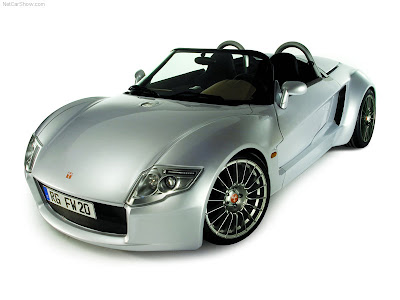
Roadster 3.2 Turbo the concept was taken one-step further: an especially developed rear wing spoiler assures the necessary down force, to bring 355 HP safely onto the street.


The »YES Roadster 3.2 Turbo« is a driving machine that relocates limits. The person driving it has to be capable of accelerating 930 kg in 3.9 seconds to 100 km/h. it is a balancing act between dominating and being dominated. The power is transferred unaltered onto the streets. This is what requires the Turbo driver utter concentration. An experience you will never forget.

The interior is the human-machine interface. This is where the driver takes the command, feels the direct contact to the street, navigates and controls the instruments.


The high-strength aluminum-space-frame takes care of the passive safety. In addition, driver and passenger are protected by optional air bags if necessary.


With variable camshaft settings, the renowned V6 four-valve engine equipped with 3,189 cm3 of engine, displacement in the naturally aspirated as well as in the turbo version combined with a max. Torque already at 2,001 1/min has virtually an easy job with the 890 and 930 kg respectively of the »YES! Roadster 3.2 and 3.2 Turbo In doing so, the fuel consumptive on is only at eight, two and nine, 3 liter respectively on 100 km in the so-called combined fuel consumption.


A 6-speed-manual transmission or alternatively the 5-speed-automatic transmission together with a lengthwise build in power train takes care of the power transmission onto the rear wheels. A rather low shifting effort and precise, short shifting travels allow fast and exact gear changes.


Ventilated brake discs on the front axle as well as on the rear axle provide a maximum deceleration and a well-balanced braking power - also during a continuous run. 4-piston fixed calipers onto the brake discs transfer the braking power.


The pedal force is transferred directly in favor of a superior pedal feel, optionally supported by a Multi-Channel ABS-system which is directly derived from racing.

In addition to the usual high level of passive safety, full-size driver's and passenger's airbags are available for the »YES! Just in case.


We want you to enjoy it as often as possible: open driving. Therefore, we have also found space in the YES. Optional and mostly for the cold season is the new hardtop - easily and quickly assembled the YES! Roadster turns into a coupe!

Sunday, October 11, 2009

1988 Audi quattro

1988 Audi quattro


The Audi Quattro was a famous and historically significant Audi road and Rally car. It was special in that it was the first AWD Grand Tourer since 1966's Jensen FF. Officially, the model name is simply "Quattro", always with a capital "Q" (although the graphics on the car, confusingly, refer to the AWD system and use a lowercase "q"). The word "quattro" with the lowercase "q" is used to refer to either the Audi AWD system, or any AWD version of an Audi automobile. To avoid confusion, it is also commonly referred to as the Ur-Quattro (the "Ur-" prefix is a German augmentative used, in this case, to mean "original" and is also applied to the first generation of Audi's S4 and S6 sport sedans, as in "UrS4" and "UrS6"). European Distribution Audi released the original Quattro in 1980, making it both the first car to feature Audi's quattro All Wheel Drive system (hence its name) and the first to mate quattro with a turbocharged engine. The powerplant was a 2.1 L, single overhead cam, 10 valve straight-5 originally making 160 hp (149 kW) and eventually receiving upgrades to 200 hp and then to a twin-cam setup producing 220 hp (164 kW). It is considered one of the most significant rally cars of all time, and was one of the first to take advantage of the then-recently changed rules which allowed the use of all-wheel-drive in competition racing. Many critics doubted the viability of all-wheel-drive racers, thinking them to be too heavy and complex, yet the Quattro was an instant success, winning its first rally on its first outing. It won competition after competition for the next two years. Total road car production is around 11,000 vehicles over the period 1980-1991. The body style received very little modification during its production run, the only significant changes were made for the 1985 model year, which included a new sloping front grill, headlights, trim and badging changes. All Quattros were hand built in Germany by a dedicated crew. North American Distribution Sales of the Quattro in North America began with the 1983 model year and continued through 1986. Total sales in the USA was 664 units. The Audi Sport Quattro The Audi Sport Quattro was a Quattro program car developed for Group B rallying homologation, and sold as a production car in limited numbers it featured a different body shell and a significantly shorter wheelbase.

1985 Audi Sport quattro S1

1985,Audi,Sport,quattro,S1,car


1985 Audi Sport quattro S1,car,kaufen,2009


The Audi Sport Quattro S1 was introduced at the end of 1984 as an update to the Audi Sport Quattro. The car featured a inline 5-cylinder engine that displaced 2,110 cc (128.8 cu in) and produced an officialy quoted figure of 350 kW (480 PS/470 bhp). However, the turbocharger utilised a recirculating air system, with the aim of keeping the turbo spinning at high speed, and the actual figure was in excess of 500 bhp (373 kW/507 PS) at 8000 rpm. In addition to the improved power output, an aggressive aerodynamic kit was added that featured very distinctive wings and spoilers to the front and rear of the car to increase downforce. The weight was lightened to just 1,090 kg , and now accelerate from 0-100 km/h (62 mph) in just 3.1 seconds. Some of the cars were supplied with a "power-shift gearbox", which is said to be a forerunner of today's Direct-Shift Gearbox technology. The S1 proved to be an immediate success in the rally circuit, helping Walter Röhrl and Christian Geistdörfer win the 1985 San Remo Rally. A modified version of the S1, was also driven by Michèle Mouton. The S1 evolution would become the final Group B car produced by Audi, with the works team withdrawing from the Championship following the 1986 rally in Portugal. Twenty years after the cancellation of Group B, the Sport Quattro S1 was still widely regarded as the most powerful rally car ever fielded in international competition, with the final factory machines of 1986 rated at an incredible 441 kW. In addition to Group B competition, the S1 won the 1985 Pikes Peak International Hill Climb with Michèle Mouton in the driving seat, setting a world record time in the process. This victory was repeated in 1987, this time at the hands of Walter Röhrl, and again in 1988 and 1989 completing a hat-trick.